The Economics of B50: When the B50 Mandate Weighs Down Domestic CPO Price Anchor

President Prabowo Subianto recently highlighted the significant difference between the contract price of Indonesia's crude palm oil (CPO) exports and the prevailing prices in the international market. In the Plenary Cabinet Session on July 20, 2026, the President noted that Indonesia's CPO price ranged from IDR 14,000 to IDR 15,000 per kilogram, while the price in Rotterdam could reach around IDR 27,000 per kilogram. This nearly 50 percent difference raises an important question: who benefits from the value between these two prices?
This question is reasonable. For Indonesia, as the world's largest CPO producer, the significant value difference between the origin and destination markets indeed deserves open examination. Moreover, changes in CPO prices ultimately relate to the price of fresh fruit bunches (FFB) received by farmers.
In the same spirit of transparency, the Indonesian Oil Palm Farmers Association (APKASINDO) has launched HargaSawitIndonesia.id. This platform brings together FFB price data from various provinces with several CPO reference prices, including KPBN tenders, Bursa Malaysia, ICDX, and Rotterdam. This initiative is commendable as it provides broader market information access to farmers, the government, and the public.
However, data transparency must also be accompanied by caution in interpreting each figure. The price of IDR 15,000 in Indonesia and IDR 27,000 in Rotterdam may not necessarily be at the same delivery point, transaction time, quality, and cost structure. The quoted price in the destination market may include freight, insurance, port charges, and other trade components, depending on the transaction basis used. On the other hand, the netback export value that Indonesian exporters can realize is influenced by exchange rates, export levy, export duty, as well as logistics and transaction costs borne by the exporter.
Therefore, these two figures must first be placed on a comparable basis. However, even after all these adjustments are made, one more fundamental question remains: is the movement of global CPO prices still directly and proportionally transmitted to the domestic CPO market?
The answer is increasingly complex. This is because the structure of Indonesia's CPO demand is changing.
Understanding Prices and Withdrawals at KPBN
The tender prices of PT Kharisma Pemasaran Bersama Nusantara (KPBN) often draw attention as they are used as one of the important references in the palm oil industry. However, KPBN is not an institution that can set prices at will. Tenders essentially match the prices offered by buyers with the prices expected by sellers.
The highest bid indicates the upper limit of the buyer's willingness to pay at a certain time, quality, volume, and delivery location. After receiving the offer, the seller can accept it or propose a counter price. The counter indicates the price still expected or deemed reasonable by the seller.
If the counter is accepted, a transaction can be agreed upon. Conversely, if the buyer is unwilling to follow the counter, the tender ends with a withdrawal or WD status.
Thus, WD does not always mean there is no demand or no party needs CPO. The buyer is present and makes an offer, but the price expected by the seller has not met the buyer's economic threshold.
The recent frequency of WD occurrences does not automatically indicate that KPBN is not trying to obtain higher prices. The counter can actually be seen as the seller's effort to maintain CPO value by considering broader market developments, including prices in Malaysia and Rotterdam. However, the seller's desire to obtain higher prices does not automatically increase the buyer's ability to pay.
This is where the character of the buyer becomes important. Domestic CPO tenders are more favored by refineries and integrated downstream companies. Some of these companies are also exporters and global trade players. Therefore, they cannot be rigidly separated between "domestic buyers" and "export players." The same company can allocate CPO and its derivatives for food, oleochemicals, exports, and biodiesel production from fatty acid methyl ester (FAME) for domestic mandatory programs.
Increasingly Domestic-Oriented Demand
The increase in biodiesel mandates from B40 to B50 enlarges the physical CPO demand in the domestic market. Based on the 2026 allocation calculation, the implementation of B40 from January to June requires about 1,134,362 tons of CPO per month. After B50 is implemented from July to December, the demand increases to about 1,417,952 tons per month.
This means an additional demand of about 283,590 tons of CPO each month, or a 25 percent increase compared to the B40 period. In six months, this additional demand reaches about 1.70 million tons of CPO.
This significant absorption changes the position of biodiesel in the domestic consumption structure. The Outlook Industri Sawit Q3 2026 published by Indonesia Palm Oil Strategic Studies (IPOSS) estimates palm oil consumption for biodiesel to reach 4.25 million tons in Q3 2026. This amount approaches 60 percent of the total domestic palm oil consumption projected at 7.2 million tons.
The players have not changed much. Of the 25 vegetable business entities (BU BBN) that received biodiesel supply allocations in 2026, most are integrated downstream companies or part of business groups that also serve the export market. These include the Wilmar, Musim Mas, Apical, Sinar Mas, Permata Hijau, First Resources, LDC groups, and several other companies.
What has changed is not merely the identity of the buyers, but the economic constraints they face when allocating CPO.
Before the mandate increased, companies had more leeway to direct their raw materials or products to destinations that provided the best returns. When the Biodiesel obligation increased, part of that allocation became a physical need that had to be secured. Biodiesel producers do not only buy when they see short-term trading opportunities. They also have to meet the volume allocated in the mandatory program.
However, the obligation to buy more does not mean companies can pay any price for CPO. Every purchase must still be within the economic limits of the downstream products to be produced.
HIP Biodiesel as a New Anchor
In the mandatory program, the economics of Biodiesel sales are related to the Market Index Price of biofuel type biodiesel or HIP Biodiesel. The HIP Biodiesel formula uses the average CPO KPBN price, plus the conversion value of raw materials into biodiesel and transportation costs. HIP is then set for a monthly period.
This mechanism creates an interesting relationship. The average CPO KPBN price in the previous period becomes one of the bases for HIP Biodiesel. The HIP applicable in the following month then forms the revenue envelope for Biodiesel producers and affects the economics of CPO purchases in the current period. The resulting CPO offer will subsequently affect the KPBN average for the next HIP calculation.
The relationship can be read as a circle:
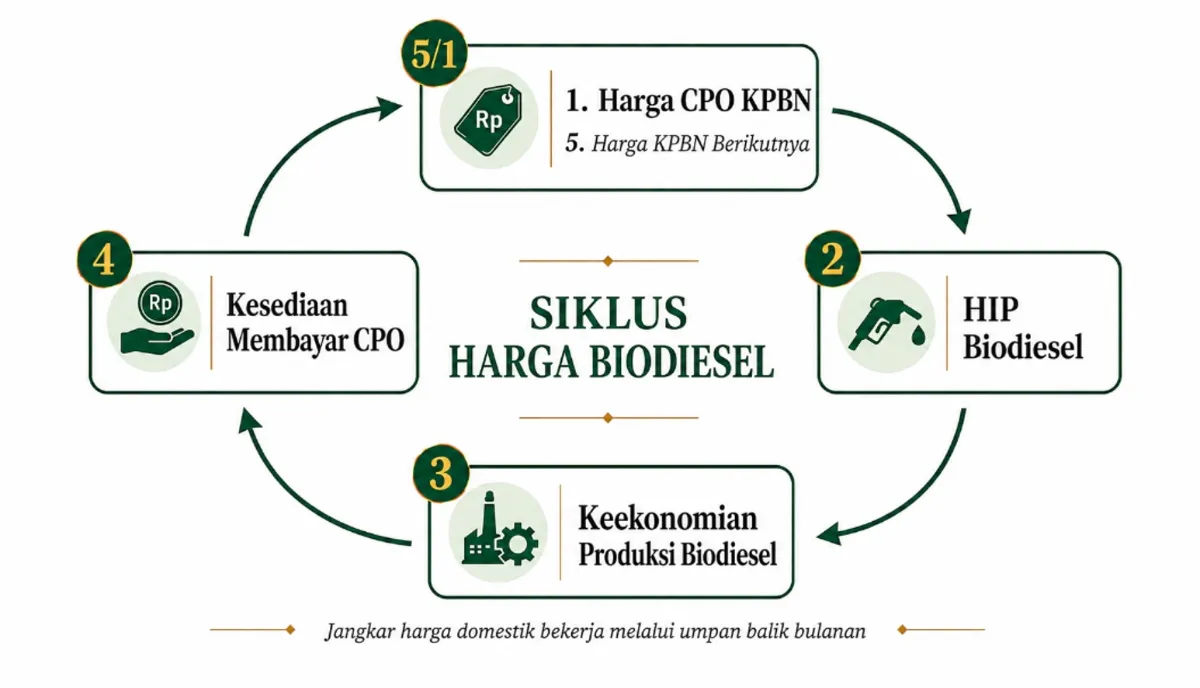
This circle does not mean HIP Biodiesel sets a permanent ceiling on CPO prices. When the average CPO KPBN price increases, the HIP in the next period can also adjust. However, because HIP applies monthly, while global prices and CPO tenders can change daily, there is a lag in price transmission.
Within one HIP period, refineries have a relatively more measurable economic range for purchases. If global prices surge in a short time, domestic offers do not have to move at the same speed and magnitude. Adjustments can occur after the Biodiesel economy for the next period also changes.
Global prices certainly have not lost their influence. Export values, exchange rates, competing vegetable oil prices, logistics costs, and product allocation choices remain part of company decisions. However, the larger the volume of CPO absorbed for mandatory Biodiesel, the greater the portion of demand that moves according to domestic rhythm and economics.
In other words, the B50 mandate not only increases domestic CPO demand. It also strengthens the domestic price anchor and slows the transmission of global price changes to the Indonesian CPO market.
The implications do not stop at B50. If the mandate is later increased to B60, B70, or even B100, the larger the portion of CPO absorbed into the domestic demand scheme. In such conditions, the weight of HIP Biodiesel and the economics of Biodiesel production as a domestic price anchor will become stronger, while the transmission of global price changes to the local market may become increasingly indirect.
What Does It Mean for FFB Prices?
These changes need to be understood in discussions about farmers' FFB prices. Global CPO prices remain important, but their increase is not automatically and directly translated one-to-one into domestic CPO prices, then into FFB prices.
According to the Minister of Agriculture Regulation Number 13 of 2024, the formation of FFB prices essentially considers the value of CPO and palm kernel based on local sales prices and their yield, which is then calculated through the K index, plus the value of shells that can still be utilized and sold. Thus, the price received by farmers still relies mainly on CPO as the most dominant main product, while kernel and shells are additional components in price formation.
Price transparency and monitoring of the implementation of the FFB formula still need to be strengthened. Farmers must receive their rightful share of the sales value of CPO, kernel, and shells produced. However, if the biodiesel economy makes the domestic market increasingly have its own anchor, improving farmers' welfare can no longer rely solely on the assumption that CPO KPBN prices must always move closer to Rotterdam.
The industry needs to start looking for new sources of value creation that can increase added value, both for mills and farmers.
In the palm oil processing mass balance, each ton of FFB not only produces CPO, kernel, and shells. The process also produces empty bunches, fibers, and palm oil mill effluent or POME. These various biomass and waste streams are not merely residues but resources that can be further processed into economically valuable products, such as fertilizers, biopellets, biochar, biogas that can be upgraded to bio-CNG, and renewable electricity. Through appropriate technology pathways, some of these streams can also become raw materials for the development of low-carbon fuels, including biodiesel, HVO, and sustainable aviation fuel or SAF.
The creation of value can even surpass the sale of physical products. The utilization of residues and waste to replace fossil energy, capture methane, or store carbon has the potential to generate measurable emission reductions. If it meets the requirements of methodology, additionality, and a credible measurement, reporting, and verification system, the benefits of these emission reductions can be further monetized through carbon trading. Thus, the entire mass balance of FFB actually holds much broader potential for creating new value in the green economy.
The next policy question is how this new value can be created and monetized, and then its benefits distributed more equitably. The green economy value should not stop at the downstream units that carry out processing, while farmers continue to receive only the value from conventional components that have been known for decades.
Therefore, the mechanism for value creation and distribution needs to be well-designed. Economic feasibility, risk sharing, investment needs, asset ownership, and benefit distribution must be thoroughly considered so that the green transformation can support the sustainability of the oil palm industry while also improving the welfare of farmers and other stakeholders from upstream to downstream.
The attention of the President and APKASINDO to the price disparity has opened an important discussion on value distribution in the palm oil industry. The economic perspective of biodiesel adds a new layer: the change in domestic demand structure means that global prices are no longer automatically and immediately transmitted to Indonesian CPO prices. As the biodiesel economy increasingly anchors domestic prices, the agenda for farmer welfare also needs to move further—from merely pursuing commodity price increases to the creation, monetization, and distribution of new value generated through the green transformation of the palm oil industry.
Pamungkas, D. H. (2026). The Economics of B50: When the B50 Mandate Weighs Down Domestic CPO Price Anchor. IPOSS Researcher Opinion, OP-2026-VIII-015. Indonesia Palm Oil Strategic Studies. https://iposs.co.id/en/opini/the-economics-of-b50-ketika-mandatori-b50-memperberat-jangkar-harga-cpo-domestik