What is STD-B in Oil Palm Plantations?
The issue of palm oil legality often arises when discussions turn to plantations located in forest areas, land overlaps, or incomplete plantation business administration. However, this issue should not be viewed merely as a matter of regulation. Legality should be seen as an entry point to improve palm oil governance from the plantation level, strengthen the position of smallholders, and maintain the competitiveness of Indonesian palm oil in the global market. One important initial step is the Plantation Business Registration Certificate for Cultivation or STD-B.
Palm oil legality is primarily related to the certainty of land status. Plantations located in other land use areas certainly have different administrative pathways compared to those "already" situated in forest areas. For business activities established in forest areas without forestry permits, the government has regulated a resolution mechanism through Government Regulation Number 24 of 2021. This regulation includes the inventory of business activities, resolution of oil palm plantation activities in forest areas, administrative sanctions, and administrative fines. In other words, improving legality cannot be achieved with just one document but must follow the status and issues of the land. Therefore, plantation data collection becomes an important step to clearly determine the status, location, and condition of the plantation.
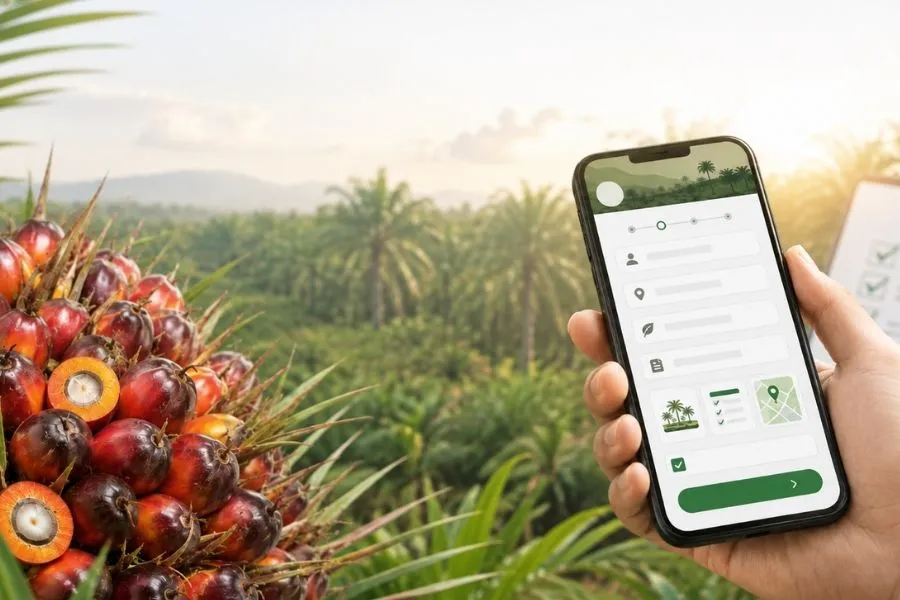
STD-B becomes an important instrument in the data collection and improvement of smallholder palm oil legality. STD-B is not a business permit but rather a form of legal administrative evidence for plantation cultivation owned by smallholders. Through STD-B, data on smallholders, plantation location, land area, commodities, land tenure status, and plantation information can be recorded more neatly. This data is crucial because many smallholder palm oil issues stem from incomplete basic information about who the smallholders are, where their plantations are, how large their land is, and what their land tenure status is.
With the existence of STD-B, smallholders can more easily enter the government's guidance system. This data collection also serves as a basis for promoting access to smallholder oil palm replanting programs, technical assistance, partnerships, certification, and productivity improvement. In facing market demands and regulations such as EUDR, STD-B also becomes an important part of efforts to strengthen the traceability of the palm oil supply chain. Without well-organized plantation data, smallholders will find it more difficult to connect with sustainability systems and markets that increasingly demand product origin certainty.
For companies, legality does not stop at business permits. Companies also need to ensure compliance with spatial planning, forest area status, land rights, environmental obligations, partnerships, and plantation business reporting. Law Number 39 of 2014 on Plantations serves as an important foundation in the administration of plantation businesses, including orderly, sustainable management in accordance with statutory regulations. Meanwhile, for smallholders, strengthening STD-B is an initial step to ensure plantations are recorded, guided, and directed towards more orderly governance.
Legality is also the foundation of sustainability. In Presidential Regulation Number 16 of 2025, the Indonesian Sustainable Palm Oil Certification System or ISPO is defined as a system for palm oil plantation businesses, downstream industries, and palm oil bioenergy that is socially, economically, and environmentally viable in accordance with statutory regulations. This means sustainability cannot be separated from legal compliance.
Therefore, the future of palm oil requires legality that is built gradually and inclusively. The government needs to strengthen spatial data collection, resolve plantations in forest areas, issue STD-B, assist smallholders, and integrate legality with sustainable certification. For smallholders, STD-B is not just an administrative document but an entry point to gain recognition, guidance, program access, and a stronger position in the palm oil supply chain. For the industry, legality strengthens traceability and the reputation of the supply chain. Ultimately, legality is not just a matter of permits but a foundation to ensure Indonesian palm oil is more orderly, productive, sustainable, and competitive.