← News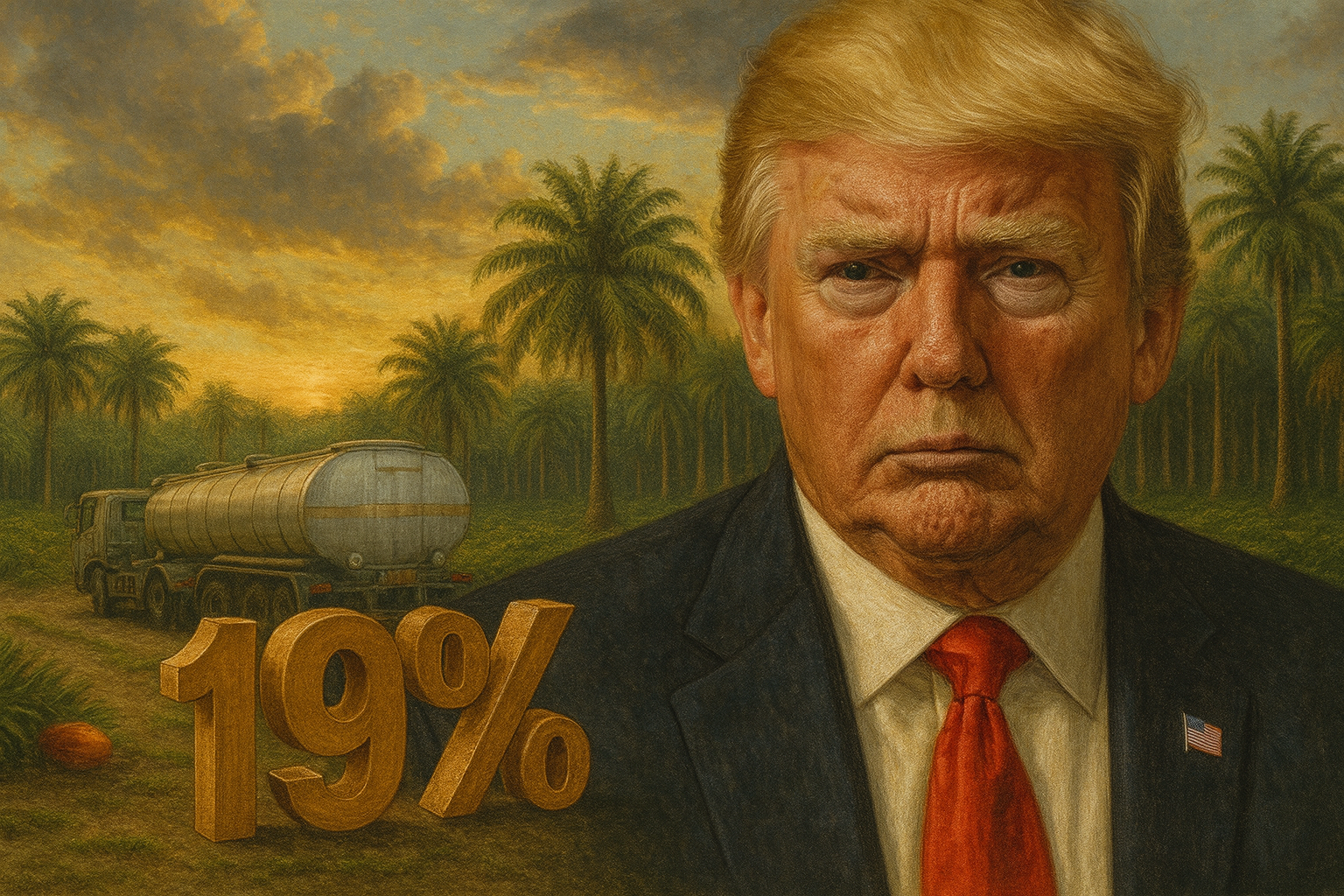
July 29, 2025533 views
Hooray, Palm Oil Import Tariff to US Below 19 Percent
After President Trump reduced import tariffs from Indonesia from 32 percent to 19 percent, there is now more good news: palm oil, rubber, and cocoa are being given special treatment. In further negotiations led by the Coordinating Minister for Economic Affairs, these three commodities will be subject to tariffs below 19 percent. The exact rates have not yet been announced.
This incomplete information is reassuring for Indonesia and will certainly be good news for those involved in the palm oil industry. Understandably, the United States is one of Indonesia's top five palm oil export destinations. With tariffs reduced below 19 percent, the price of palm oil and its derivatives from Indonesia in the United States is believed to be very competitive compared to palm oil from Malaysia.
"We are also given less than 19% for natural resource commodities that America does not produce, such as oil palm, cocoa, and rubber," said Airlangga at the Investor Daily Round Table (IDRT) event at Hotel Mulia, Jakarta, Monday (July 28, 2025) as quoted by the online media BeritaSatu.
According to Airlangga, besides the persistence of negotiators in advocating for low tariffs for various Indonesian commodities, tariffs below President Trump's benchmark are categorized as a sweetener or bonus in the trade cooperation scheme between the two countries. This clause can be achieved considering that these leading Indonesian products do not have domestic substitutes in the US, thus not causing direct competition with their local products. This is the main consideration in granting preferential tariffs.
Reportedly, the Indonesian negotiation team continues to push the United States to obtain special tariffs for various other natural resources not available in Uncle Sam's country. It is hoped that, although Indonesia is required to purchase several US commodities in significant quantities, with these special tariffs, it will ultimately create a bilateral trade surplus for Indonesia.
This good news should be appreciated by the Indonesian nation. With a 19 percent tariff alone, Indonesian palm oil is expected to thrive in the United States, surpassing Malaysian palm oil, which is subject to a 25 percent tariff. It would be even more meaningful if the special tariff for palm oil could be reduced further to between 10-15 percent, or at least 10 percent below that of the neighboring country. This is not impossible considering palm oil in the United States is a basic necessity for food that is almost "irreplaceable," such as for making butter and others.
Psychologically, the success of Indonesian palm oil in penetrating the US market massively will also enhance the image of Indonesian palm oil, which has been perceived as unhealthy by some in the international community. Once it thrives in Uncle Sam's country, penetrating new markets around the world will be relatively easy.
As predicted by several experts, the success of Indonesian palm oil in the United States will also boost palm oil negotiations with the European Union, which will soon implement the EUDR. Although there will not be significant changes, the implementation of the EUDR may be more lenient and more favorable to palm oil farmers who have not yet fully implemented traceability.
We all hope that Indonesian palm oil will soon flood the United States starting early August when the new tariffs are applied. If in recent years Indonesian palm oil exports to Uncle Sam's country have continued to increase, then we will usher in a golden era of palm oil as a result of smart negotiations.