← News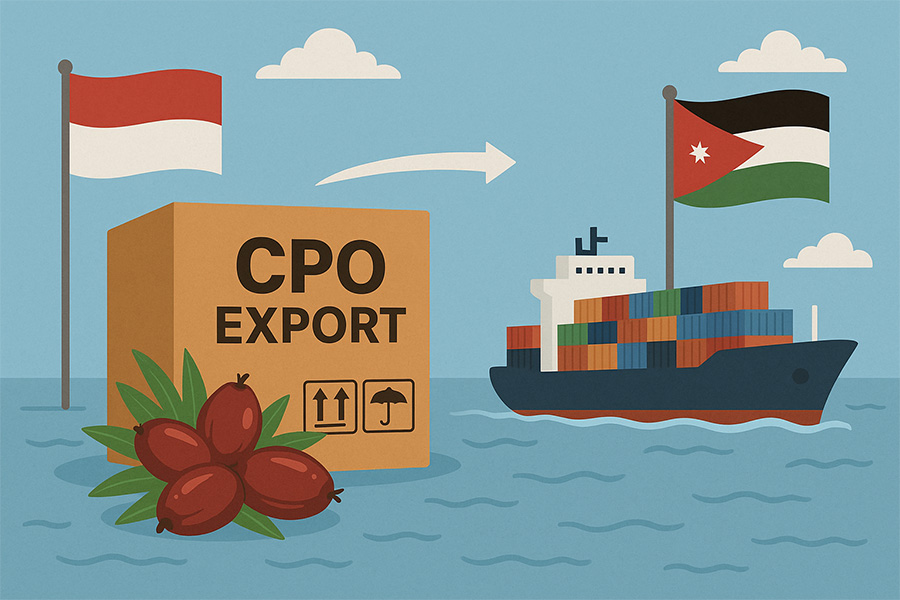
April 28, 2025118 views
Indonesia Targets New Market Via Jordan
There is no giving up. When several countries restrict palm oil imports, especially from Indonesia, the Government continues to seek new markets that are still very feasible. Even President Prabowo himself promotes it during state visits.
Indonesian palm oil seems to be in a tight spot. The European Union is attempting to hinder it with the implementation of the deforestation law (EUDR) at the end of this year, India is trying to reduce imports by developing its own plantations, while the United States is imposing very high tariff barriers. At the same time, CPO prices are creeping up above the prices of several other vegetable oils.
Although the situation is not very favorable, Indonesia never loses hope. All stakeholders still believe that palm oil is still very much needed as a consequence of human growth and its needs. Moreover, its downstream benefits continue to increase over time.
It is not surprising that Indonesia is now increasingly aggressive in expanding its palm oil export markets. President Prabowo Subianto himself is marketing palm oil with clear language. Through bilateral meetings with King Abdullah II of Jordan in Amman, for example, marking a new chapter of collaboration expected to strengthen Indonesia's dominance in the global palm oil industry.
According to data from Databoks Katadata (20/2), Indonesia exported approximately 24.21 million tons of palm oil throughout 2024, with export values reaching around USD 22.87 billion. This value is indeed still far from India's imports, which average 5 million metric tons per year. However, opening new chapters of palm oil exports in various parts of the world can eventually replace those who are no longer willing to cooperate with us. As the saying goes, little by little, it becomes a hill.
The signing of a memorandum of understanding (MoU) between Indonesia and Jordan (15/4) covers various aspects, including increasing palm oil exports, developing the downstream industry, and human resource training. With support from the Indonesian Palm Oil Association (GAPKI), this cooperation is expected to increase the volume of Indonesian palm oil exports to the Middle East, particularly to Jordan and surrounding countries.
According to the 2024 One Data Agriculture report, Jordan is not yet among the largest palm oil importing countries in the world or in the Middle East region, a position still dominated by countries such as India, China, Egypt, and the United Arab Emirates. Nevertheless, the potential for market growth remains wide open. This is evidenced by reports from Antara News, where the Jordanian government expressed readiness to import palm oil (CPO) from Indonesia in large quantities without volume restrictions, depending on their industrial needs.
Based on the latest population projection data, Jordan's population is estimated to reach around 11 million by 2025. With the growth of the food, energy, and other downstream sectors, demand for palm oil-based products, such as cooking oil and biodiesel, is predicted to increase in the coming years.
GAPKI, as the palm oil business association, plays an important role in supporting government policies to make palm oil a strategic commodity. GAPKI Chairman Eddy Martono stated that they are ready to synergize with the government in facing global challenges and maintaining the competitiveness of Indonesia's palm oil industry. One concrete step proposed is the establishment of a Palm Oil Agency, which will manage this sector more structurally and efficiently.
Although the Middle Eastern market offers great potential, there are challenges to be faced, such as strict regulations and competition with similar products from other countries. However, with this cooperation, Indonesia can utilize Jordan as a gateway to enter a wider market in the region. In addition, the development of downstream products such as biodiesel and oleochemicals is also a main focus to increase the added value of Indonesia's palm oil exports.
The cooperation between Indonesia and Jordan in the palm oil sector is a strategic step that strengthens Indonesia's position in the global market. With support from GAPKI and government commitment, it is hoped that Indonesia's palm oil industry can grow rapidly and make a significant contribution to the national economy. ()