River as Alternative Route for Palm Transport
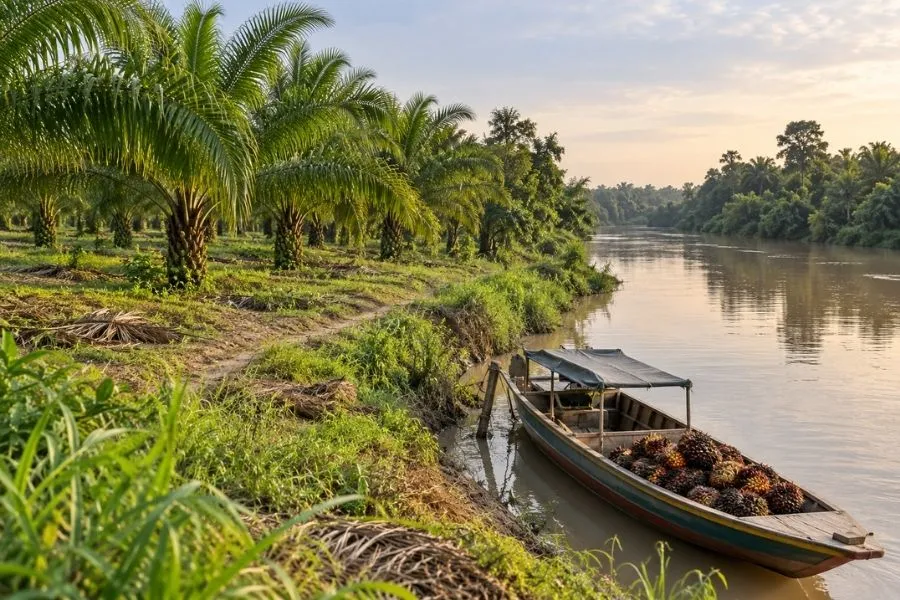
The transportation of oil palm harvests is generally associated with trucks traversing plantation roads to palm oil mills (PKS). However, in several regions of Riau, fresh fruit bunches (FFB) are transported using boats via river streams. This practice demonstrates how farmers utilize local geographical conditions to support plantation activities, especially when road access is inadequate.
One example is found in the Sungai Kampar area, Riau. According to RRI (2026), some farmers with plantations near the river use motorboats to transport FFB to collection points or traders. The presence of the river provides an alternative route that allows the harvest to be marketed even when road access to the plantations is limited.
The use of river routes is important because FFB needs to be transported and processed immediately after harvesting to maintain its quality. Delays in processing can lead to an increase in free fatty acid (FFA) levels, which affects the quality of palm oil. Therefore, the availability of adequate transportation routes, including via rivers, plays a role in helping to ensure the smooth distribution of the harvest.
Interestingly, the need for river transportation also drives the development of technology adapted to local conditions. Research by Saputra (2026) from Politeknik Negeri Bengkalis notes that FFB transportation in Desa Simalinyang, Kampar Regency, still uses motorboats with a capacity of less than 2.5 tons. This capacity limitation requires multiple trips for transportation. To address this, the research designed a boat with a capacity of 3.5 tons, equipped with a conveyor system and an operational speed planned to reach 7 knots. This design shows the potential for increased transport capacity, although the cost-efficiency of operations still needs to be proven through direct application.
However, using rivers is not always more practical or economical compared to land transportation. During the dry season, reduced water flow can cause shallowing that hinders boat travel. Conversely, strong currents during the rainy season can increase safety risks. Fuel costs, labor, and loading and unloading processes can also add to farmers' expenses. This means that the presence of rivers as a transportation route does not necessarily result in lower distribution costs.
Besides economic aspects, the use of rivers must consider their ecological functions. Rivers not only support plantation activities but also serve as habitats for aquatic organisms and sources of livelihood for communities. Therefore, FFB transportation must be conducted with attention to navigation safety, prevention of fuel pollution, and protection of riverbank areas.
The experience of farmers in Sungai Kampar shows that geographical conditions can be utilized to support the distribution of plantation products. Nevertheless, river transportation should be viewed more as a complement to land routes rather than a complete replacement. The use of both according to regional conditions can provide more transportation options for farmers, while also helping to ensure the smooth marketing of the harvest.