← News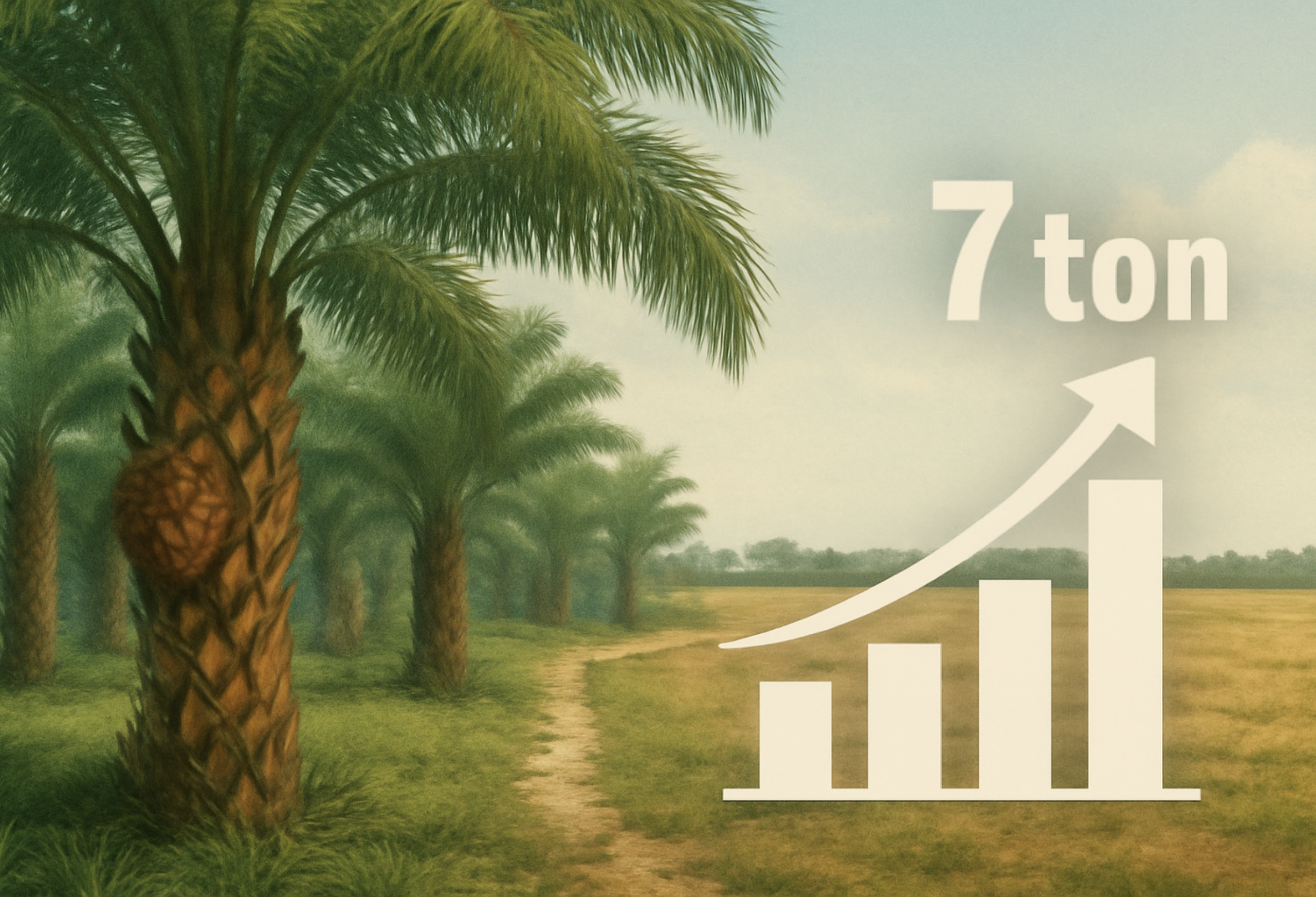
June 20, 2025651 views
Without Expansion, Can Indonesia Produce More Palm Oil?
Imagine if Indonesia could significantly increase its palm oil yields without clearing a single hectare of forest. Amid global scrutiny over deforestation and sustainability demands, such a move would be a major breakthrough. Although it has not yet fully materialized, the opportunity remains open. The Indonesian government is now determined to increase national palm oil productivity to 7 tons per hectare per year without opening new land. This strategy not only addresses environmental pressures but also provides an economic solution for national palm oil farmers.
The Ministry of Agriculture (Kementan) states that this productivity increase target will be achieved through three main approaches: rejuvenating old plants, intensifying existing palm oil plantations, and using appropriate technology. This means that instead of expanding palm oil plantations into new forest areas, Indonesia intends to maximize the potential of existing land.
One of the main focuses is the Smallholder Oil Palm Replanting (PSR) Program, which has been running since 2017. This program targets oil palm plants over 25 years old, whose production has drastically declined. According to Kementan data, about 2.8 million hectares out of a total of 6 million hectares of smallholder palm oil land fall into the category of old plants and need immediate rejuvenation. The Minister of Agriculture at the time, Syahrul Yasin Limpo, stated on May 16, 2023, that palm oil rejuvenation is a strategic step. "According to President Joko Widodo's directive, improvements are needed from the upstream sector of smallholder oil palm plantations... The PSR program is targeted at 180,000 hectares annually," he said while launching the PSR Task Force in Jakarta.
Entering 2025, this commitment was reaffirmed. The Director General of the Plantation Fund Management Agency (BPDP), Eddy Abdurrachman, in a meeting with the House of Representatives on February 17, 2025, explained that the PSR realization in 2024 reached 38,247 hectares with funds disbursed amounting to IDR 1.295 trillion. "It has not reached the target due to several field constraints," he revealed. Meanwhile, in March 2025, BPDP launched PSR Wave III covering 4,222 hectares in Sumatra, Kalimantan, and Sulawesi.
Normansyah Hidayat Syahruddin, Director of Fund Collection at BPDP, added in a February 2025 meeting that PSR is part of the commitment to improve farmer welfare and increase national productivity, in line with the mandate of the Minister of Agriculture Regulation Number 3 of 2022 and 19 of 2023. This means that the strategy is not only continued but also adjusted to the latest technical developments and policies.
With rejuvenation and superior seeds, smallholder palm oil, which previously produced only 2–3 tons of palm oil per hectare, can increase two to three times. Large companies like Astra Agro Lestari and other business groups have shown that the application of clonal seeds, tissue culture, and precision agriculture practices can increase productivity by 20–25 percent. Digital technology and smart farming are also being introduced to small farmers, although the scale is still limited.
This approach not only impacts yields but also farmer welfare. Haskarlianus Pasang from Sinarmas Agribusiness and Food stated that if farmers can increase their productivity to 6 tons per hectare, Indonesia could add up to 36 million tons of national palm oil production—all without expanding land. This is crucial, given that national productivity has tended to stagnate in recent years, with production around 52 million tons in 2024, down from 54 million tons in 2023.
Although the increase in palm oil productivity is promising, challenges in the field remain significant. Many small farmers still lack access to superior seeds, replanting financing, and modern agricultural technology training. Supporting infrastructure in palm oil production centers also needs to be strengthened to facilitate the distribution of products and production tools. Without comprehensive improvements, achieving high productivity evenly is difficult.
Conversely, if these challenges can be overcome, the strategy of increasing yields without opening new forests will strengthen Indonesia's position in the global market and improve the image of palm oil as a sustainable commodity. Supported by appropriate policies, product downstreaming, and bioenergy development such as biodiesel B35 to B50, the palm oil industry has the potential to become an important pillar of future energy and exports. This transformation not only improves farmer welfare but also proves that Indonesia can grow sustainably and responsibly.