← News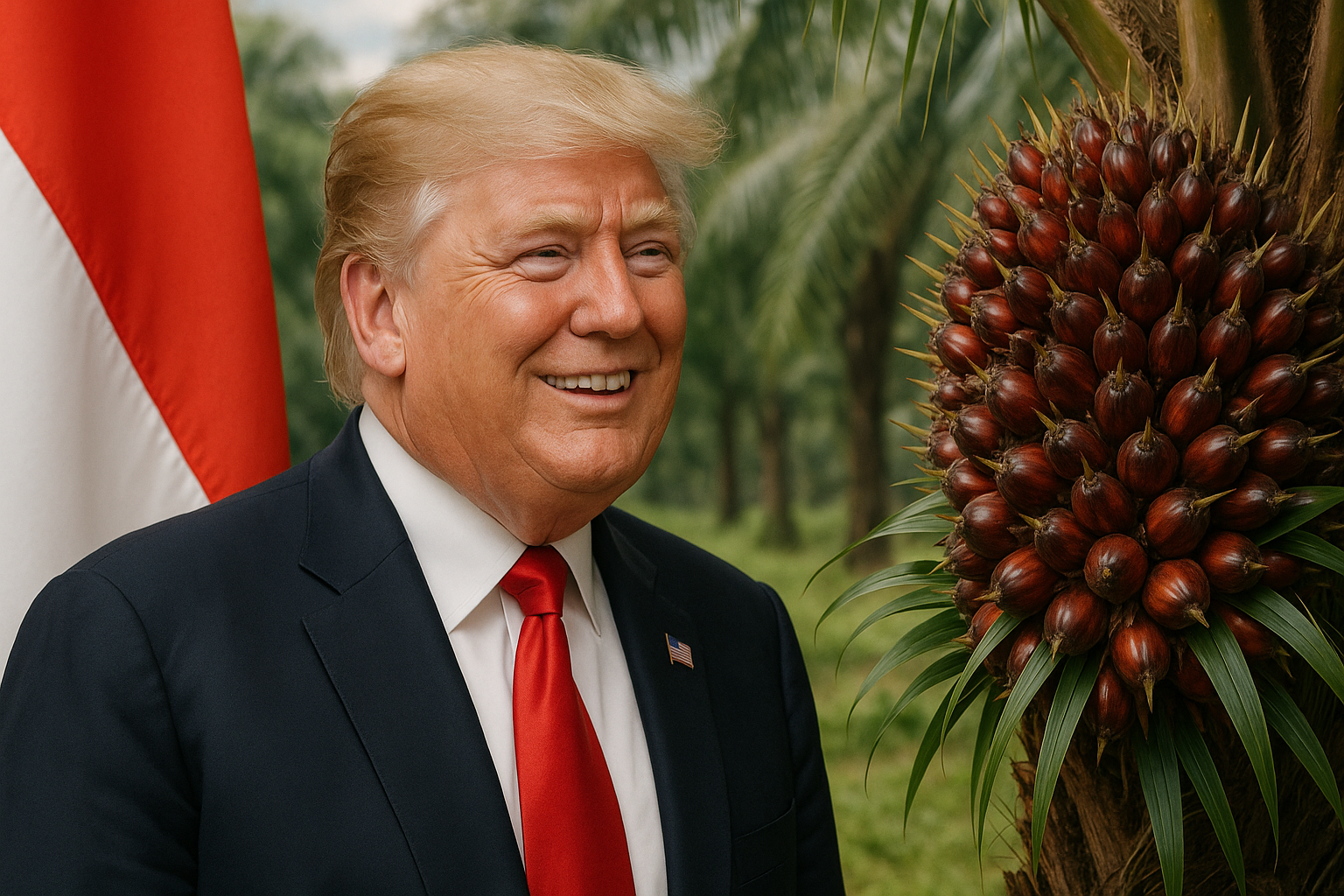
July 25, 2025139 views
Trump Tariff Now 19%, Will Indonesian Palm Oil Thrive in US and EU?
After direct negotiations between presidents, President Trump finally announced that Indonesian products entering the United States would only be subject to a 19 percent tariff, down from the 32 percent set at the beginning of July. For some economists, this figure is still considered quite high and negatively impacts several Indonesian products, considering that the tariff for U.S. products to Indonesia is 0 percent. But it's a different story for products like palm oil and its derivatives.
The Minister of Agriculture (Kementan), Andi Amran Sulaiman, warmly welcomed the new tariff and is optimistic that in the future, Indonesian palm oil will "dominate" the United States. The excitement of the Minister, often referred to as "Mr. Clean," is quite reasonable because the same product from Indonesia's main competitor, Malaysia, is subject to a higher tariff of 25 percent. This 6 percent tariff difference is what makes the Minister extremely delighted.
"We are grateful, (from the initial discourse of 32 percent) it has now dropped to 19 percent. Malaysia 25 percent. What does this mean? There is an opportunity there for Indonesian agriculture. There is an opportunity there for Indonesian CPO," said Amran, as quoted by Inilah.Com, Friday (July 18, 2025). "Malaysia 25 percent, Indonesia 19 percent, right? So if our CPO enters, which one wins? Indonesia," he added.
Currently, Indonesia is the largest exporter of crude palm oil or CPO and its derivatives, competing quite closely in capturing the U.S. market share with neighboring Malaysia. In the list of 14 countries subject to tariffs by Trump in early July, Malaysia was subject to 25 percent or 6 percent higher than Indonesia currently. Although our exporters are burdened with relatively more domestic levies, the calculations on paper are still cheaper when marketed in the United States.
In general, last year, the highest importers of crude palm oil or CPO and its derivatives from Indonesia were India (4.3 million tons), followed by Pakistan (3 million tons), China (2.3 million tons), and the United States (1.4 million tons), then Bangladesh (1 million tons). The Indonesian Palm Oil Association (GAPKI) hopes that with the right government policy support, palm oil exports to the United States can soon reach 3 million tons per year.
In an interview with Sawit.IDN, GAPKI Chairman, Eddy Martono, stated that U.S. demand for Indonesian palm oil products has increased significantly from year to year. Many end products in the United States can only be made well using palm oil. Therefore, the results of bilateral negotiations between Indonesia and the United States will determine further U.S. demand in the coming years.
At almost the same time, good news also came from the European Union. The completion of the IEU-CEPA negotiations was officially announced in a bilateral meeting between President Prabowo Subianto and the President of the European Commission, Ursula von der Leyen, in Brussels, Belgium, on Sunday (July 13, 2025). This joint commitment was achieved after Indonesia conducted 19 rounds of negotiations with the European Union over nearly a decade.
It is hoped that this agreement will soon be finalized and signed by both parties in September this year. Thus, the IEU-CEPA provides the possibility for Indonesia and the European Union trade to become tariff-free or 0 percent. President Prabowo even mentioned that all traded products would become zero tariff.
However, specifically for agricultural products, there are still obstacles from the European Union with the implementation of the EUDR at the end of this year. This means that palm oil exports to the region, starting next year, must meet various pro-environmental requirements such as traceability elements.
Above all, many analysts believe that the palm oil commodity will have an increasingly shining image in Europe after the signing of the IEU-CEPA, as well as the successful negotiations between Indonesia and the United States that reduced the tariff from 32 percent to 19 percent. Now both parties just need to push through negotiations so that crucial issues can be compromised. (1)