Indonesian Palm Oil Effluent (POME) Now Officially Recognized as Sustainable Aviation Fuel (SAF)
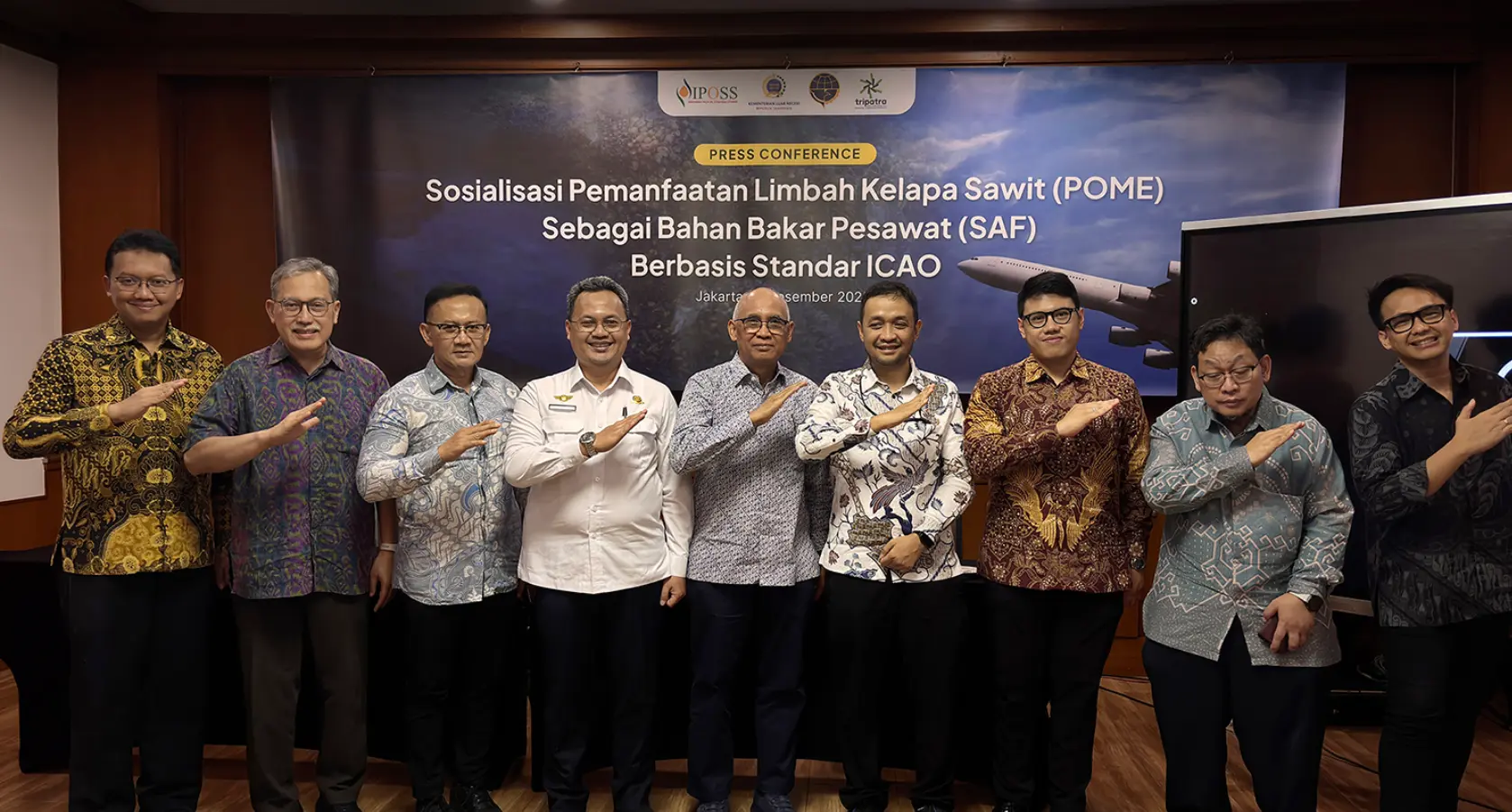
Jakarta, December 11, 2025 - Based on information from the Ministry of Transportation (Kemenhub), global air passenger growth is projected to exceed 8 billion passengers annually by 2041, which will automatically significantly increase aviation emissions. Without intervention, these aviation emissions are estimated to reach 21.2 gigatons of CO2 (equivalent to 4.6 billion cars operating for one year) by 2050. In light of these factors, the International Civil Aviation Organization (ICAO) has set a net zero emission target for 2050 as a global goal with a flexible approach according to each country's capacity. One of the initiatives being promoted for cleaner aviation is making Sustainable Aviation Fuel (SAF) a key mitigation instrument.
/wp:paragraph wp:paragraphIndonesia itself, as a global citizen projected to have 390 million air passengers annually by 2037, must adapt to sustainable aviation standards. It is not surprising that Indonesia has committed to various climate commitments such as the Paris Agreement, ICAO CORSIA, and Net Zero 2060. Our courage is partly driven by the awareness that Indonesia has a tremendous potential to develop a national SAF industry and become a global player through government-industry collaboration.
/wp:paragraph wp:paragraphIndonesia is a country with extraordinary SAF raw material potential. Unfortunately, until mid-last year, we had never initiated its resources to be converted into SAF. Used cooking oil and non-standard coconut oil, which have been recognized as SAF materials by ICAO, were instead proposed by other countries. Therefore, since the end of last year, Indonesia has been concerned with certifying palm oil mill effluent (POME), which was previously largely wasted, to be processed into SAF. If this effort proceeds smoothly, Indonesia will not only be known as an environmentally friendly nation but also become a supplier of sustainable aviation fuel rich in foreign exchange. This also means we will be able to start making SAF a component of aviation fuel as planned (by 2030).
/wp:paragraph wp:paragraphThe Government's initiative (Kemenhub and the Ministry of Foreign Affairs (Kemenlu)), supported by various parties, especially IPOSS and Tripatra, began moving to propose POME—an oil palm industry residue—as a SAF raw material to the ICAO in November 2024. IPOSS's participation as a palm oil policy think tank is to oversee and synchronize the steps of all parties to ensure harmony in proof, calculation, and technical-level negotiations. IPOSS is also involved in the calculation debates conducted in Europe, Latin America, and at ICAO headquarters. Meanwhile, Tripatra is involved in calculating the default LCA value and planning the first investment in POME SAF production.
/wp:paragraph wp:paragraphExactly one year into the process, at the end of November 2025, POME was officially approved as a SAF material by including the default LCA Value of POME in the ICAO Document “CORSIA Default Life Cycle Emissions Values for CORSIA Eligible Fuels”, with a default LCA value of 18.1 gCO2e/MJ. This value is very low (79.6% below aviation fuel emissions).
/wp:paragraph wp:paragraphWith this decision, POME can officially be used as a raw material for SAF production. Under international law, Indonesia now has the opportunity to become a producer of SAF from POME needed by the world in the coming decades. Palm oil waste (POME) is now not just waste but is recognized as an internationally certified low-carbon aviation fuel.
/wp:paragraph wp:paragraphThe positive impact on the aviation industry includes encouraging the mandatory implementation of SAF for the aviation industry (international and domestic) with regulatory foundations for the use of SAF, which includes POME-based SAF. With the potential of all raw materials already recognized by ICAO (POME, UCO, PFAD), Indonesia has the potential to supply 2-3 million kiloliters of SAF, thus the direction of SAF implementation needs to be pushed towards a 5% mandate by 2030 or even sooner for national and international flights. Last but not least, this success facilitates claiming emission reductions by airlines under the CORSIA scheme because the value is already default-approved. ()
/wp:paragraph