Palm Oil in Europe: A Field Note from an Ambassador
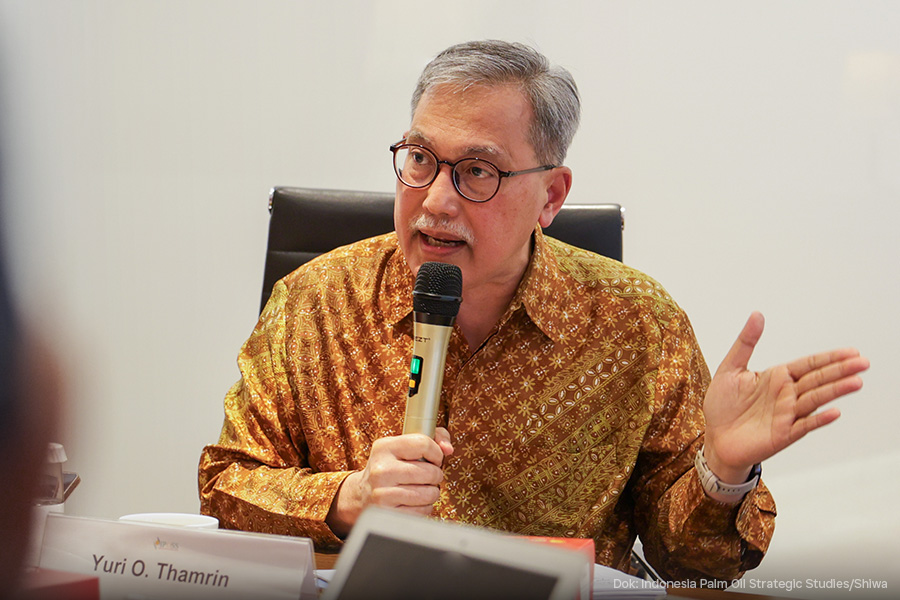
By: Yuri O. Thamrin
This note is not written for nostalgia, but for a more practical purpose: cross-fertilization—sharing experiences among Indonesian Embassies/Representatives on how 'palm oil diplomacy' is conducted in different fields. Each post has a unique political context, media, and local actors. However, the pattern of challenges is similar: regulations, industry lobbying, and public opinion often intertwine. Hopefully, this field note can serve as a basis for exchanging experiences—what is effective, what is less effective, and what can be adapted—so that we do not always start from scratch.
PROLOGUE: THIS IS NOT JUST A COMMODITY—IT'S ABOUT FAIRNESS
If there is one issue that was most "energy-draining" in Indonesia–European Union relations during my tenure as the Indonesian Ambassador in Brussels, it was oil palm. In Brussels, palm oil was not just discussed as a trade item. It transformed into a political symbol, an environmental campaign tool, and sometimes—honestly—a field of economic competition wrapped in a moral narrative.
During my tenure in Brussels, the wave of green politics ("greening of politics") was strengthening: environmental and climate change issues became mainstream, not only belonging to the Green party but also permeating other political groups. The consequence was clear: the space for palm oil was increasingly "strangled".
At the policy level, a major challenge arose when the European Union enacted the Renewable Energy Directive (RED II) and then the Delegated Regulation on ILUC, categorizing palm oil as high-ILUC-risk—with a policy direction to gradually phase out from the end of 2023 to 0% by 2030.
At the business level, there was also pressure—for example, the European Biodiesel Board filed an anti-subsidy complaint against Indonesian biodiesel.
At the public opinion level, there were "palm oil-free" campaigns, misleading claims, and even boycotts—such as the boycott movement associated with the British supermarket (Iceland) at the end of 2018.
In short: this is a perfect storm—regulations, industry lobbying, and public opinion synergizing.
THE BATTLEFIELD OF BRUSSELS: THREE ARENAS AT ONCE
Managing palm oil issues in Europe is not a "one-door" job. It must be done in parallel, as the EU architecture is indeed multi-institutional:
1. European Commission (technocratic-regulatory)
2. European Parliament (political-narrative-opinion)
3. European Council/Council of the EU (member states—national interest calculations).
Therefore, the Indonesian Embassy in Brussels implements a consistent approach: constructive, continuous, and parallel—not only to EU institutions but also to the embassies of palm oil-producing countries, businesses, associations, think tanks, and media.
STRATEGY OF THE INDONESIAN EMBASSY IN BRUSSELS: "TOTAL DIPLOMACY" THAT IS GROUNDED
During 2016–2020, palm oil diplomacy was also strengthened by political "top cover": high-level visits and official letters from the President, Foreign Minister, Trade Minister, Speaker of the House of Representatives—emphasizing Indonesia's rejection of palm oil discrimination—were delivered to EU institution leaders and relevant commissioners.
However, on the ground, there are several playbooks that have proven important:
1. Build alliances with palm oil producers: do not fight alone.
The Indonesian Embassy in Brussels formed alliances with the embassies of palm oil-producing countries (Malaysia, Thailand, Honduras, Colombia, Ecuador, Nigeria, Ivory Coast, Kenya) through regular monthly working group coordination.
The logic is simple: if this issue is "framed" as a problem of one country, we are easily defeated. If it is positioned as a problem of fairness and a balanced approach to developing countries' commodities, the resonance is different.
2. Joint collective letters: tying the issue to the EU leadership level.
The Indonesian Embassy in Brussels led the drafting of 3 joint letters from the ambassadors of palm oil-producing countries to the leaders of the European Parliament, European Commission, European Council, and the Presidency of the Council of the EU. These collective letters are important to "elevate" the issue from technical debates to high-level political attention.
3. Joint demarche and methodology: ILUC must be debated.
The Indonesian Embassy in Brussels initiated a joint demarche of the ambassadors of palm oil-producing countries to the Council/COREPER handling RED II issues—voicing rejection of the ILUC methodology and urging the opening of dialogue for a more balanced EU approach and consideration of SDGs.
Here, the core of the battle is often not "whether the environment is important" (everyone agrees), but rather methodology, assumptions, and fairness: whether the policy is evidence-based, non-discriminatory, and provides space for sustainable palm oil.
4. Enter the "rhythm" of the European Council: regular dialogue with the Trio Presidency.
The Indonesian Embassy in Brussels initiated regular dialogue with the Trio Presidency of the Council of the EU (Romania, Finland, Croatia) along with palm oil-producing countries.
This is a step that is often underrated—yet many important decisions "mature" in the Council's pathway.
5. Manage the "public stage": multi-stakeholder events and public campaigns.
/wp:paragraph wp:paragraphThe Indonesian Embassy (KBRI) organizes multi-stakeholder events to build open dialogue and convey Indonesia's positive developments regarding sustainable palm oil.
/wp:paragraph wp:paragraphPublic campaigns are also conducted, such as producing a documentary film about sustainable palm oil in collaboration with TV Kanaal Z, and participating as speakers in palm oil/deforestation forums.
/wp:paragraph wp:paragraphBecause in Europe, perception often becomes policy. Once public opinion is "firmly convinced," policy simply follows.
/wp:paragraph wp:paragraph6. "Bring them to see": facilitate MEP visits to Indonesia.
/wp:paragraph wp:paragraphThe Indonesian Embassy (KBRI) facilitates visits by Members of the European Parliament to Indonesia to review sustainable palm oil (INTA Delegation May 2017, and DASE/AFET May 2018).
/wp:paragraph wp:paragraphThis is the most effective way to break stereotypes: not debating in meeting rooms, but seeing the supply chain, field practices, and social realities.
/wp:paragraph wp:paragraph7. Face trade accusations with evidence discipline: anti-subsidy biodiesel case.
/wp:paragraph wp:paragraphIn the anti-subsidy issue, the Indonesian Embassy (KBRI) along with the Ministry of Trade (Kemendag) participated in hearings with the EU Commission and the case investigation team to assert Indonesia's position (not acknowledging the accusations), supported by evidence, together with stakeholders such as BPDP, PTPN, Aprobi, and biodiesel exporters.
/wp:paragraph wp:paragraphThe key here is: their rule-of-the-game is evidence, data, and consistency of arguments—not anything else.
/wp:paragraph wp:paragraphREADING EUROPE'S MOTIVES: NOT JUST "ENVIRONMENT"
/wp:paragraph wp:paragraphOn paper, the narrative is environmental. But the reality of competition also exists: palm oil faces competition from European vegetable oils like rapeseed and sunflower—especially in the biofuel sector.
/wp:paragraph wp:paragraphAnd at the consumer level, the "palm oil-free" label often becomes a marketing trick that confuses and shapes negative perceptions.
/wp:paragraph wp:paragraphTherefore, managing palm oil issues in Europe must acknowledge two things simultaneously: (1) There is a genuine environmental concern (which needs to be seriously addressed): (2) There is also a dimension of EU domestic economic and political interests (which we must not naively ignore).
/wp:paragraph wp:paragraphPOLICY LESSON: IF THE POLITICAL DOOR NARROWS, OPTIONS MUST BE THREE-TRACK
/wp:paragraph wp:paragraphTo secure Indonesia's interests, Indonesia needs to pursue three tracks: litigation, strengthening dialogue with the EU, and (the discourse of) retaliation.
/wp:paragraph wp:paragraphThese three tracks are not for show. This is about a policy toolbox so that the EU understands that: (1) There are international/trade legal mechanisms that can be pursued; (2) There is a dialogue path that is maintained; (3) And there are consequences if discriminatory approaches are allowed.
/wp:paragraph wp:paragraphEPILOGUE: PALM OIL DIPLOMACY IS A MARATHON, NOT A SPRINT
/wp:paragraph wp:paragraphThe experience of the Indonesian Embassy in Brussels shows: palm oil diplomacy is not a single event, but a series of daily work—building alliances, maintaining networks, managing narratives, sending data, conducting demarches, preparing visits, and if necessary "fighting" in technical hearings.
/wp:paragraph wp:paragraphAnd one thing that is most important: in Europe, we cannot only win in meeting rooms. We must also win in the public space—because that is where policy often receives a "moral mandate."
/wp:paragraphThamrin, Y. O. (2026). Palm Oil in Europe: A Field Note from an Ambassador. IPOSS Researcher Opinion, OP-2026-II-004. Indonesia Palm Oil Strategic Studies. https://iposs.co.id/en/opini/sawit-di-eropa-catatan-lapangan-seorang-dubes