Palm Oil, Net-Zero 2050, and a New Paradigm of Space-Based Sustainability Efficiency

Introduction: Net-Zero in a Finite World
/wp:paragraph wp:paragraphThe world is moving towards the net-zero 2050 target. The aviation and shipping sectors—which are difficult to fully electrify—position biofuels as one of the main pillars of decarbonization. Sustainable Aviation Fuel (SAF) is projected to become the backbone of the aviation sector's transition, while the maritime sector, under the International Maritime Organization's decarbonization strategy, also promotes the use of low-carbon fuels such as biodiesel and Hydrotreated Vegetable Oil (HVO).
/wp:paragraph wp:paragraphHowever, in the global sustainability discourse, the evaluation of biofuels is still heavily dominated by a carbon intensity-based approach. Regulatory frameworks such as the Renewable Energy Directive II (RED II) and the Carbon Offsetting and Reduction Scheme for International Aviation (CORSIA) from the International Civil Aviation Organization place emission reduction thresholds as the main parameter. In the CORSIA scheme, a fuel is considered to meet sustainability criteria if it shows an emission reduction based on life cycle assessment (LCA) of at least 10 percent compared to the conventional jet fuel baseline of 89 gCO₂e/MJ.
/wp:paragraph wp:paragraphThis approach is important and its methodology has been consistently developed. However, it remains product-centric—calculating emissions per unit of product without explicitly considering the spatial implications of a massive increase in global demand.
/wp:paragraph wp:paragraphIn the context of net-zero 2050, the issue of space becomes unavoidable. Every additional volume of plant-based biofuel production requires additional land, and the extent of this additional land entirely depends on the productivity of the plants used. In a world facing land-use change pressures—which have been identified as one of the critical thresholds in the planetary boundaries framework (Rockström et al., 2009; Steffen et al., 2015)—the spatial dimension can no longer be considered a secondary variable.
/wp:paragraph wp:paragraphGlobal Vegetable Oil Spatial Structure
/wp:paragraph wp:paragraphThe global vegetable oil system is dominated by four main commodities: soybean, oil palm, rapeseed, and sunflower. However, the distribution of land area and productivity shows a very sharp contrast.
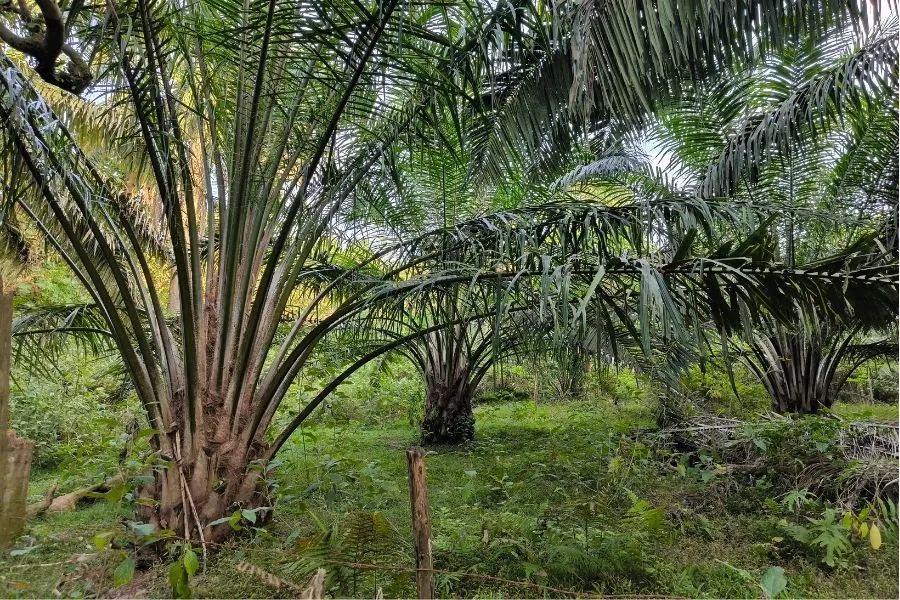
/wp:paragraph wp:paragraphSoybean is planted on approximately 139.7 million hectares of global land, making it the vegetable oil commodity with the largest land allocation, with a production of about 70 million tons of oil per year. Rapeseed occupies about 41.5 million hectares with a production of around 25 million tons, and sunflower about 28.2 million hectares with a production of around 22 million tons. Meanwhile, oil palm uses only about 26.9 million hectares of land globally but produces nearly 90 million tons of oil per year. This means that oil palm's land use is much smaller compared to soybean, but with a much higher oil production achievement.
/wp:paragraph wp:paragraphIn terms of productivity, oil palm produces about 3.0–5.0 tons of oil per hectare per year, while rapeseed and sunflower are in the range of 0.6–0.8 tons per hectare, and soybean around 0.4–0.5 tons per hectare (Corley & Tinker, 2016; Oil World, 2022). Thus, oil palm can produce six to eight times more oil per hectare compared to soybean.
/wp:paragraph wp:paragraphMathematically, land requirement is a direct ratio between demand volume and productivity per hectare. With global vegetable oil consumption around 230 million tons per year (FAO, 2023), variations in plant productivity result in very different spatial implications. At a productivity level of 4 tons per hectare—like oil palm—the land requirement is around 57 million hectares. Conversely, at a productivity of about 0.45 tons per hectare—like soybean—the land requirement can exceed 500 million hectares to meet that demand. This difference shows that productivity is not just a technical variable but a structural factor in determining global spatial pressure.
/wp:paragraph wp:paragraphThis difference of hundreds of millions of hectares illustrates a very large ecological pressure difference on a global scale. In this perspective, oil palm can be understood as the plant with the highest spatial efficiency in the world's vegetable oil system.
/wp:paragraph wp:paragraphDecarbonization 2050 and the Energy Scale Challenge
/wp:paragraph wp:paragraphThe discourse on spatial efficiency becomes increasingly relevant when linked to the global decarbonization target towards 2050. The aviation sector, which is technologically difficult to fully electrify, places Sustainable Aviation Fuel (SAF) as the main pillar of the net-zero strategy. Projections from various international bodies, including the World Economic Forum (WEF) and the International Air Transport Association (IATA), indicate that SAF demand by 2050 could reach around 400 to 500 million tons per year to support the net-zero of the global aviation industry. This figure is almost double the current total global vegetable oil consumption.
/wp:paragraph wp:paragraphIf SAF on the scale of hundreds of millions of tons is produced from vegetable oil-based raw materials, then the issues of productivity and land efficiency become very crucial. The difference between plants with a productivity of 4 tons per hectare and 0.5 tons per hectare is no longer just an agronomic gap; it means hundreds of millions of additional hectares of land requirement.
/wp:paragraph wp:paragraphA similar situation applies to the shipping sector. The decarbonization strategy for the maritime sector adopted by the International Maritime Organization encourages the use of low-carbon fuels, including biofuels, as one of the transition pathways. If biodiesel or other liquid biofuels are widely used to replace marine fuel oil, the demand for vegetable oil-based feedstock will also increase significantly.
/wp:paragraph wp:paragraphThus, the 2050 decarbonization target implicitly carries implications for global land use on an unprecedented scale. Energy transition is no longer merely a matter of technology and carbon intensity, but also a matter of space and its distribution.
/wp:paragraph wp:paragraphAt this point, land efficiency shifts from merely an agronomic advantage to a strategic variable in the security of the global energy transition. High-yield crops enable the world to meet decarbonization targets with more controlled land pressure. Conversely, choosing low-productivity feedstock could potentially increase the risk of land expansion, spatial planning conflicts, and increased emissions due to land use changes.
/wp:paragraph wp:paragraphIn this context, the debate on the sustainability of vegetable oils cannot be separated from the architecture of global decarbonization. The question is no longer merely which commodity has lower emissions intensity per liter, but which commodity allows the world to achieve net-zero without exceeding planetary space limits.
/wp:paragraph wp:paragraphIf the transition to net-zero 2050 is not accompanied by careful spatial calculations, the world risks replacing dependence on fossil carbon with land-based ecological pressure. Therefore, the selection of vegetable feedstock in the decarbonization agenda is not only about carbon efficiency but also about spatial efficiency.
/wp:paragraph wp:paragraphILUC and the Urgency of Reformulating Spatial Justice
/wp:paragraph wp:paragraphThe dimension of land use change in the CORSIA discourse has indeed been considered through the concept of Indirect Land Use Change (ILUC). This issue is specifically discussed in the ICAO Working Group and addressed by the ILUC Sub-Group, which updates the GTAP-BIO and GLOBIOM models as modeling approaches currently referenced in land change risk assessments.
/wp:paragraph wp:paragraphHowever, the development of technical discussions shows that the construction of ILUC is still heavily influenced by model assumptions—particularly related to shock size, region definition, and global trade and production responses. Even within the technical forum itself, it is acknowledged that certain approaches have the potential to “over-penalize certain pathways.” Significant differences in results between models indicate that the ILUC value is not a final scientific constant but a modeling outcome sensitive to the parameters used.
/wp:paragraph wp:paragraphIn the context of CORSIA, the ILUC value for CPO as a SAF feedstock is around 39 gCO₂e/MJ, while soybean oil is around 25.8 gCO₂e/MJ. This difference becomes crucial when linked to the reality of productivity and land use between commodities. Palm oil has significantly higher productivity per hectare compared to soybean oil, thus mathematically requiring much less space to produce the same volume.
/wp:paragraph wp:paragraphIf the risk of land use change is fundamentally related to the additional space required due to increased demand, then land efficiency should be a central variable in ILUC risk assessment. Without the explicit integration of spatial productivity variables, ILUC models may not fully represent land change risks proportionally.
/wp:paragraph wp:paragraphThis is where the urgency for conceptual reformulation arises. Not to eliminate ILUC, but to refine it. The energy transition towards net-zero 2050 demands an evaluation architecture that is not only sensitive to global market dynamics but also to the physical reality of limited space.
/wp:paragraph wp:paragraphIn this context, the idea of Spatial Justice in Energy Transition becomes relevant. Justice in energy transition is not only measured by carbon intensity but also by how spatial burdens are distributed rationally and proportionally. Integrating spatial efficiency into the ILUC construction is not a political demand but a logical consequence of systemic sustainability principles.
/wp:paragraph wp:paragraphTowards a Spatial Efficiency-Based Sustainability Paradigm
/wp:paragraph wp:paragraphThe energy transition towards net-zero is not only a matter of carbon reduction but must also be positioned as a matter of global spatial burden distribution. Crops that require six to eight times less land to produce the same volume have different spatial implications compared to low-productivity crops.
/wp:paragraph wp:paragraphThis means that sustainability needs to move from a product-centric paradigm to a system-centric one. From merely carbon intensity to spatial efficiency. Because the future of energy sustainability will inevitably be replaced by vegetable oils, and for that, this decarbonization paradigm should already be shifting towards serious attention to spatial justice in crops that are more efficient in space utilization. This is what can be called the Spatial Sustainability Paradigm—a framework that integrates land productivity as a core variable in global sustainability evaluation.
/wp:paragraph wp:paragraphTherefore, it is worth questioning anyone who defines sustainability indicators whether the sustainability of this earth will continue to uphold such a flawed paradigm?
/wp:paragraph wp:paragraphConclusion: Reformulating the Sustainability Paradigm Net-zero 2050 will test not only the world's ability to reduce emissions but also its ability to manage space wisely. In the scale of demand for hundreds of millions of tons of biofuel in the future, differences in productivity are no longer merely agronomic details but structural determinants of the direction of global land use.
/wp:paragraph wp:paragraphBy: Dimas H. Pamungkas
(Researcher on Indonesian Oil Palm Sustainability)
Thamrin, Y. O. (2026). Palm Oil, Net-Zero 2050, and a New Paradigm of Space-Based Sustainability Efficiency. IPOSS Researcher Opinion, OP-2026-II-002. Indonesia Palm Oil Strategic Studies. https://iposs.co.id/en/opini/sawit-net-zero-2050-dan-paradigma-baru-keberlanjutan-berbasis-efisiensi-ruang