Before Planting Oil Palm, What to Consider About Peatlands?
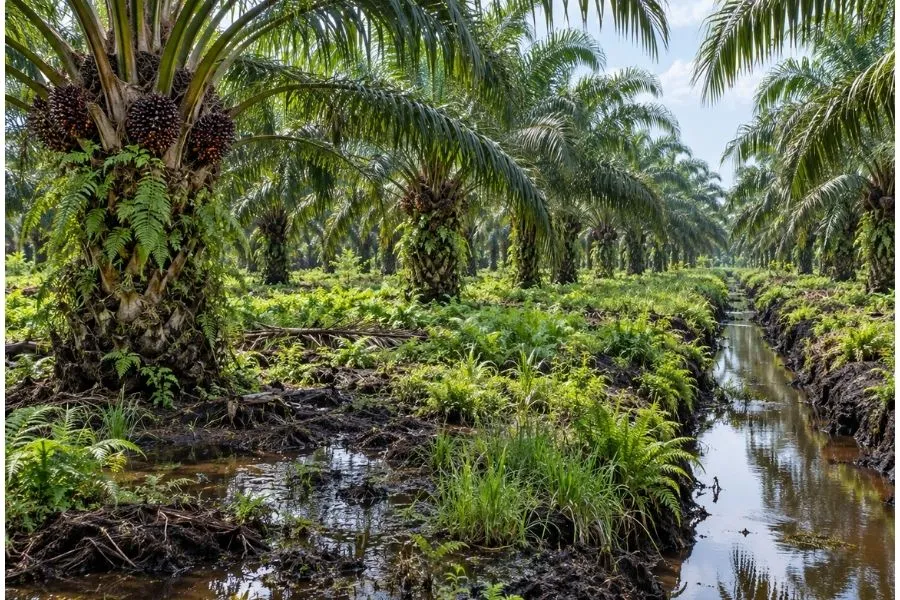
Oil palm is known as a plant capable of growing in various land conditions, including peatlands. However, oil palm cultivation on peat cannot be treated the same as on mineral soil due to different physical and chemical characteristics.
Based on the maturity level of its organic material, peat can be classified into fibric (raw), hemic (semi-mature), and sapric (mature), reflecting the degree of decomposition of the peat's constituent materials. This difference in maturity level affects the soil's physical properties, including its water retention capacity. This will influence land management methods for plantations. Therefore, in utilizing peatlands, it is important to maintain water availability at the right level to preserve the hydrological function of the peat.
Kebun Negeri Lama, North Sumatra, provides an interesting example of peat utilization for long-term oil palm plantations. Part of its land consists of relatively shallow and mature peat, with a thickness of about 70–150 centimeters, which has been cultivated with oil palm since 1927. To date, this cultivation has lasted for four planting generations or nearly a century (Sihombing, 2017; 2018). This case certainly cannot be generalized for all peatland management because each location has different biophysical characteristics. However, this experience shows that under certain conditions, oil palm cultivation can be sustained for a very long time if land management is conducted according to its characteristics and consistently applies proper water management.
In this management, water management becomes one of the most determining factors. Several studies also show that water management affects oil palm productivity on peatlands. Purnamayani et al. (2022) place water management as one of the keys to successful cultivation, while Rahayu et al. (2021) show that oil palm production on peat is influenced by the groundwater table height managed through plantation management.
Good water management is also important because it can reduce the risk of fire. When the water table drops too deep and the peat experiences prolonged dryness, its vulnerability to fire increases. BNPB (Badan Nasional Penanggulangan Bencana) emphasizes the importance of keeping peat wet as one of the steps to reduce fire risk, as fires on dry peat are more difficult to handle.
If water loss persists for too long, peat can experience irreversible drying, a condition where its ability to reabsorb water decreases. Excessive drying can also accelerate subsidence or the lowering of the peat surface. If this process continues, the land's function can further decline, complicating its management in the long term.
Peat that experiences prolonged dryness can also become more easily ignited, causing the peat surface to lower again. Therefore, burned peat cannot be immediately considered ready for replanting. This is where the assessment of peatland drainability becomes relevant, in considering the future utilization of a peat area. This assessment will analyze the land's ability to drain water by gravity. Several factors considered include peat thickness, groundwater table height, drainage channels, land topography to the water body's meeting point, and the potential for subsidence. The results of this assessment can serve as a basis for determining whether a land can still be managed or not at all.
To restore the hydrological function of peatlands, water management is an aspect that needs improvement. Restoration efforts can be carried out through the 3R approach, namely rewetting, revegetation, and revitalization of local livelihood. With this approach, peat restoration is not only directed at restoring environmental functions but also at ensuring that communities can continue to utilize peat resources as a basis for sustainable livelihoods.
Ultimately, peatlands are not merely "empty spaces" that can be immediately planted with oil palm. Each land has different characteristics and readiness levels, so the condition of the peat, water management, and the land's ability to support cultivation need to be understood first. On disturbed lands, restoration is also an important part before utilization is resumed. The success of sustainable oil palm cultivation on peat depends not only on the plants grown but also on how the land is managed to be productive while maintaining its hydrological function.