Oil Palm Intercropping Can Be Productive Land, If You Know How
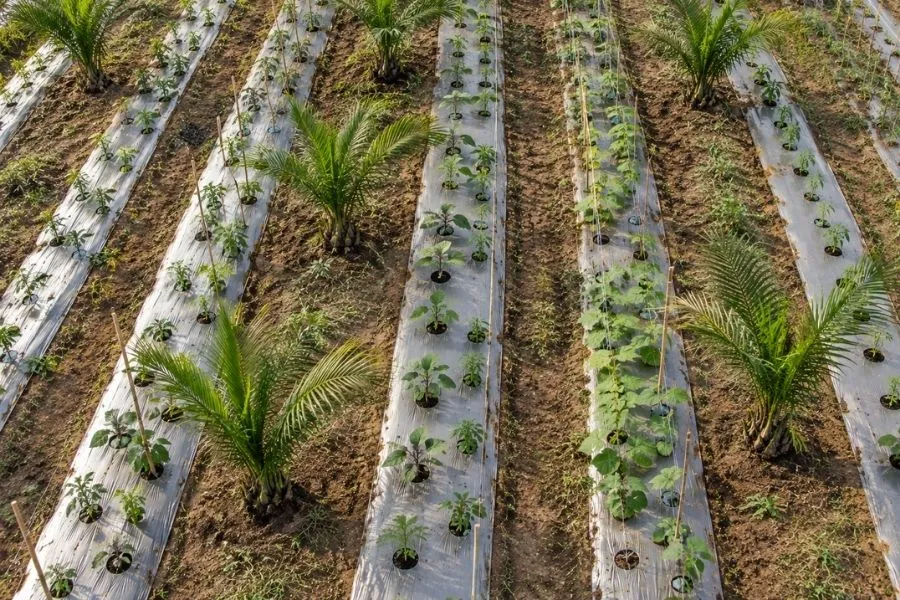
This is what is happening in Aceh Singkil. Some smallholders do not leave the space between the rows of oil palm empty. The inter-row spaces are utilized for planting vegetables so that one plot of land can produce more than one commodity. According to Tribun Aceh, the practice of intercropping vegetables in oil palm plantations is carried out by the residents of Aceh Singkil.
This method is not merely about utilizing available space. Intercropping can be an option to increase income sources, especially when the oil palm is still in the immature plant phase (TBM). Research by Nasution, Farrasati, and Sutarta (2022) in Rokan Hulu, Riau, for example, shows that eggplant, chili, bitter melon, sponge gourd, and long beans can be cultivated among young oil palms. In that study, the intercropping system did not show a decline in soil quality or vegetative growth of oil palm when the nutrient needs of each plant were met.
However, utilizing inter-row spaces does not mean all plants can be planted immediately. To ensure that intercrop plants can grow without disturbing the oil palm as the main crop, the condition of the plantation needs to be assessed first, especially the age of the oil palm and the width of its canopy (the crown part of the tree composed of fronds and leaves). In young oil palms, the canopy does not yet cover the ground, allowing ample sunlight to reach the soil surface and leaving the inter-row spaces more open. Therefore, the early TBM phase is one of the most feasible periods for intercropping.
Once the condition of the oil palm is known, the intercrop plants to be planted also need to be selected appropriately. It is important to consider the space requirements for intercrop plants so that their roots and canopies can develop, including sufficient light, water, and nutrients, allowing the intercrop plants to grow and be productive among the existing oil palms. The guidelines from the Ministry of Agriculture (Permentan) on oil palm replanting also require that the root and canopy systems of intercrop plants do not overly overlap with the main crop. Intercrop plants should not become hosts for oil palm pests or diseases and should not damage the plants or soil.
After the age and canopy width of the oil palm are known, the available space for intercrop plants can be determined. For example, with an oil palm planting distance of 9 meters, intercrop plants can utilize about 5–7 meters of space between the rows, depending on the age of the oil palm. At the age of 0–2 years, the distance of intercrop plants can be about 1 meter from the oil palm trunk, allowing for a wider planting space, while at the age of 3–4 years, a relatively safe distance is about 2 meters from the oil palm trunk. As the canopy and root system of the oil palm develop with age, this distance needs to be adjusted according to the type of intercrop plant and plantation conditions. The technical guide Intercropping in Oil Palm Plantations: A Technical Guide also emphasizes the importance of arranging the distance of intercrop plants from the oil palm trunk (World Agroforestry/ICRAF, Intercropping in Oil Palm Plantations: A Technical Guide).
The next important aspect is the market and income for smallholders. Intercrop plants with relatively short harvest periods can provide income before the oil palm starts producing. In the study in Rokan Hulu, for example, long beans, bitter melon, and sponge gourd have a planting period of about four months, while eggplant takes about six months. Therefore, intercrop plants should ideally not only grow well among oil palms but also have a market and provide economic value for smallholders.
The market determines whether intercropping truly provides economic benefits for smallholders. Commodities that are quickly harvested may not be profitable if buyer access is limited, prices are unattractive, or production and transportation costs are too high. Therefore, the selection of intercrop plants needs to consider market demand and business value, in addition to plant compatibility, oil palm age, land conditions, and management methods. This makes the practice in Aceh Singkil interesting because one plantation area can be utilized for more than one source of yield. However, intercropping is not a guarantee of additional income; its benefits can only be realized when both technical and economic aspects are met.