El Niño Is Real. Europe Burns. Where Are Our Preparations?

Strengthening Water Management to Reduce the Risk of Peatland Fires
Forest fires that have affected several countries in Europe serve as a reminder that extreme weather can increase the risk of fires in various parts of the world. For Indonesia, the forecast of a strengthening El Niño phenomenon by the Meteorology, Climatology, and Geophysics Agency (BMKG) is not merely climate information to be wary of, but a momentum to strengthen mitigation measures on the ground. The question is no longer whether the dry season will be drier, but whether our water management system is adequately prepared to face it.
For some, fire mitigation is often synonymous with increased patrols, provision of firefighting equipment, or the formation of standby teams. All of these are indeed important. However, in plantations located on peatlands, the most fundamental mitigation actually begins long before the first spark appears, namely through water management that can maintain the hydrological function of peatlands effectively.
Indonesia has had bitter experiences that have taught the importance of this approach. According to the World Bank (2016), forest and land fires in 2015 scorched approximately 2.6 million hectares with economic losses reaching around IDR 220 trillion (approximately US$16.1 billion). Most of the fires occurred in peat ecosystems, resulting in transboundary haze, disrupting public health, transportation, education, and even national economic activities. This event provided a very valuable lesson that when peat has lost its water content, the available option is no longer to prevent fires, but to struggle to extinguish them. In such conditions, fires can spread beneath the peat surface, making them much more difficult to detect and extinguish.
This experience then prompted the government to strengthen various policies for the protection and management of peat ecosystems through water management regulations, canal blocking construction, monitoring of Groundwater Level (TMAT), and restoration of peat hydrological functions as mandated in Government Regulation Number 71 of 2014 in conjunction with Government Regulation Number 57 of 2016. These various technical efforts continue to be developed by the Directorate of Peatland Ecosystem Damage Control, Ministry of Environment and Forestry, as part of a strategy to reduce fire risk while maintaining the ecological function of peatlands. On the other hand, plantation companies are also increasingly strengthening their water management systems as part of sustainable cultivation practices through regular TMAT monitoring, water gate regulation, canal network maintenance, and the construction of various water control infrastructures.
This perspective aligns with the Peat Hydrological Unit (KHG) approach developed by the Ministry of Environment and Forestry. In this approach, peat is viewed as an interconnected hydrological system, so its protection success is not only determined by conditions at one location but by the ability to maintain hydrological balance across the entire area.
However, building such infrastructure alone is not enough. What is far more important is understanding the fundamental philosophy of peat management itself.
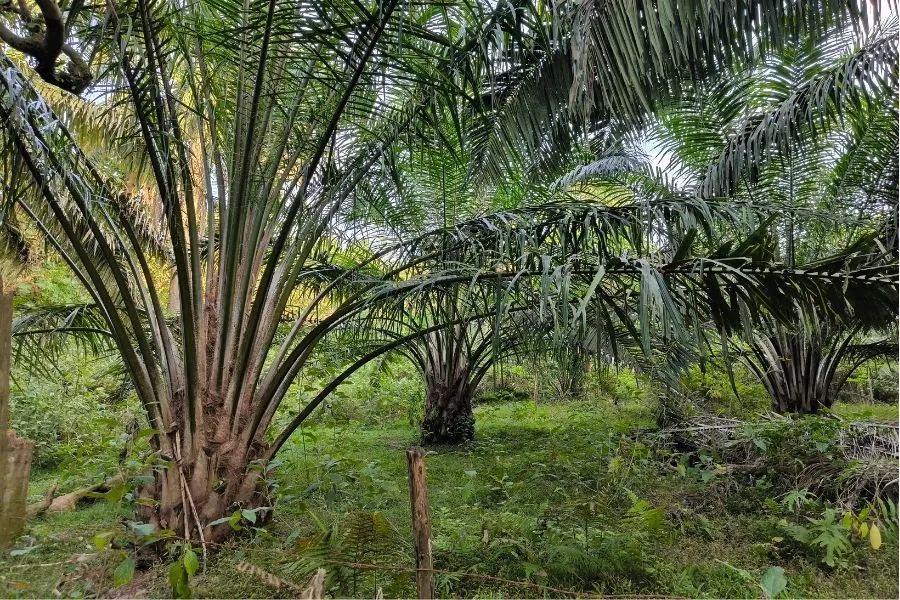
Basically, the construction of drainage systems in peatlands is not without reason. Like other cultivated plants, oil palm requires healthy root conditions to grow and produce optimally. Plant roots need oxygen for respiration. If the land is continuously inundated, the availability of oxygen in the soil will decrease, disrupting root respiration. This condition can cause root rot, hinder nutrient absorption, slow plant growth, and in certain conditions, cause plant death. Therefore, water regulation through drainage systems is an important part of cultivation practices.
However, this is where a fundamental mistake often arises. The purpose of creating a drainage system is not to remove as much water as possible until the land becomes dry, but to regulate the groundwater level to remain at a condition suitable for plant needs while maintaining the hydrological function of peatlands. Mistakes occur when cultivation approaches on mineral soil are applied directly to peatlands. Water is viewed as an obstacle that must be immediately drained out of the plantation. As a result, the groundwater level drops too deep, the peat layer loses its moisture, undergoes oxidation, experiences surface subsidence, releases carbon into the atmosphere, and at the same time becomes much more vulnerable to fires.
I still remember a sentence once conveyed by the late Mr. Edison P. Sihombing, Head of Plantations at PT Socfin Indonesia, when discussing peatland opening. He said, "The first mistake when opening peat is equating it with mineral land." This simple sentence actually summarizes the fundamental philosophy of peat management. Peat cannot be treated the same as mineral soil because it has different hydrological characteristics. Therefore, every stage of land opening should begin with understanding the land contour and hydrological system that forms a unified landscape. This information becomes the basis for designing the direction and depth of canals, block division, placement of water gates, canal blocks, and reservoirs so that water flow can be controlled according to the natural characteristics of the area.
In other words, on peatlands, it is not the water that should follow the garden design, but rather the garden design that should follow the contour and hydrological system of the peatland. Water must indeed be managed so that plants can grow well, but it is never intended to be depleted from within the peat ecosystem. Water must be maintained at the right level to ensure plant productivity while the hydrological function of the peat continues sustainably. This principle is also in line with the Best Management Practices for Oil Palm on peatlands (RSPO, 2019), which places proper water management as one of the keys to maintaining plant productivity while minimizing peat degradation.
Furthermore, water management cannot be viewed only on the scale of a single garden or company. Water flows following the contour and hydrological system of the landscape, not following administrative or concession boundaries. Therefore, the success of preserving peatlands during the dry season can only be achieved if water management is carried out in an integrated manner on a regional scale. Infrastructure such as canals, canal blocks, water gates, reservoirs, and TMAT monitoring are ultimately part of an interconnected hydrological system. When one part of the area experiences excessive drainage, the hydrological balance in other parts can also be disrupted.
Ultimately, the challenge of cultivation on peatlands is not choosing between productivity or conservation. The real challenge is how to build a cultivation system that can achieve both simultaneously, namely producing oil palm plantations that remain productive while maintaining the sustainability of the peat ecosystem. The key to achieving this balance lies in one simple yet very fundamental principle: proper water management.
At the beginning of this article, we asked, "Where is Our Preparation?" The answer may not lie in the number of fire trucks or the length of fire hoses we have. True preparation begins much earlier, when the water management system is built based on the contour and hydrological system of the area, when every water gate is ensured to function, every canal block is maintained, and the groundwater level is continuously monitored to prevent peat from losing its water.
Because ultimately, the resilience of peatlands in facing El Niño is not built when drought arrives, but when water is still preserved within them.
By: Dimas H Pamungkas
Oil Palm Senior Researcher at IPOSS
Pamungkas, D. H. (2026). El Niño Is Real. Europe Burns. Where Are Our Preparations?. IPOSS Researcher Opinion, OP-2026-VII-012. Indonesia Palm Oil Strategic Studies. https://iposs.co.id/en/opini/el-nino-itu-nyata-eropa-terbakar-di-mana-persiapan-kita