
Palm Oil Industry Outlook Q3 2026: Strengthening Domestic as a Global Palm Oil Direction Setter
Indonesia Palm Oil Strategic Studies or IPOSS released the Indonesia Palm Oil Industry Outlook Q3 2026 with the theme “Strengthening Domestic as a Determinant of Global Palm Oil Direction.” This theme emphasizes that Indonesia's palm oil industry is entering a new phase, where domestic strength no longer merely acts as a market buffer but increasingly becomes a key factor shaping the direction of the national palm oil industry and influencing the global market balance. The mandatory implementation of B50 biodiesel starting in July 2026 marks an important indicator of this change, as it increases the demand for CPO for domestic energy amid production pressures, relatively low stocks, and increasingly limited export space.
From the market fundamentals perspective, Q3 2026 is characterized by a tightening national palm oil balance. Production is expected to face pressure due to climate dynamics, particularly the tendency for dry conditions associated with the strengthening of the El Niño–Southern Oscillation (ENSO) index and the Indian Ocean Dipole (IOD). The combination of these two phenomena indicates that climate pressure can affect palm oil production areas more broadly, both through El Niño's influence on national rainfall patterns and a positive IOD that can strengthen dry tendencies in parts of Indonesia. At the same time, domestic consumption is increasing quite strongly, especially from the biodiesel sector. This combination makes the supply space for exports more limited, so export allocation increasingly plays a role as an adjustment variable in maintaining the balance between domestic needs, stocks, and foreign markets.
In this outlook, global CPO prices are projected to gradually strengthen from around USD 1,230 per ton in July 2026 to around USD 1,260 per ton in September 2026. This strengthening is mainly influenced by the tightening of export supply, low stocks, and increased CPO absorption in the domestic market due to the implementation of B50. However, the room for price increases remains influenced by CPO's competitiveness against other vegetable oils. On the other hand, the global market will still be sensitive to changes in competing vegetable oil prices, especially soybean oil as the closest competitor to palm oil.
In the domestic market, CPO prices are expected to be at a relatively strong level. After being around IDR 15,198 per kilogram in June 2026, domestic CPO prices are projected to increase to around IDR 15,548 per kilogram in July and IDR 15,590 per kilogram in August, before slightly correcting to around IDR 15,202 per kilogram in September 2026. This movement indicates that domestic prices not only follow global price signals but are also influenced by the structure of the Export Levy and Export Duty policies, as well as the increasing domestic biodiesel demand that increasingly dominates domestic demand and affects price formation in the local market.
This outlook also emphasizes that the challenges of the palm oil industry in Q3 2026 are not only in the market and prices but also in policy governance. Evaluation of cooking oil DMO, formation of state-owned export enterprises, B50 biodiesel financing, readiness to face EUDR, smallholder palm oil productivity, and the need for supply chain data integration are important issues that need to be managed carefully. In this context, strengthening domestic means ensuring that domestic policies can maintain a balance between food, energy, and export needs, while still considering state revenue, industry competitiveness, and farmer welfare.
Strengthening domestic also needs to be placed within the framework of the long-term transformation of Indonesia's palm oil industry. Future production increases can no longer rely on land expansion but must be directed towards intensification, the use of certified superior seeds, improvement of smallholder plantation governance, and acceleration of Smallholder Oil Palm Replanting. Thus, domestic strength is not only supported by increasing demand but must also be balanced with strengthening the supply side. Therefore, productivity, governance, sustainability, and the industry's ability to meet global market standards become increasingly important agendas, urgent, and determine the competitiveness of Indonesian palm oil in the future.
Through the Indonesia Palm Oil Industry Outlook Q3 2026, IPOSS hopes this document can serve as a strategic reference for the government, business actors, academics, media, and other stakeholders in understanding the direction of national palm oil industry development. This outlook emphasizes that Q3 2026 is an important period to test Indonesia's ability to strengthen the domestic market as a foundation for global competitiveness. At the same time, production pressures, increased domestic consumption, limited export space, biodiesel financing, and sustainability demands should be read as cautionary signals in policy formulation. Therefore, strengthening the palm oil industry in the future requires more measured policies, stronger coordination, and improved governance from upstream to downstream so that the national palm oil industry remains resilient, productive, competitive, and sustainable.
Read the report
More from Palm Oil Outlook
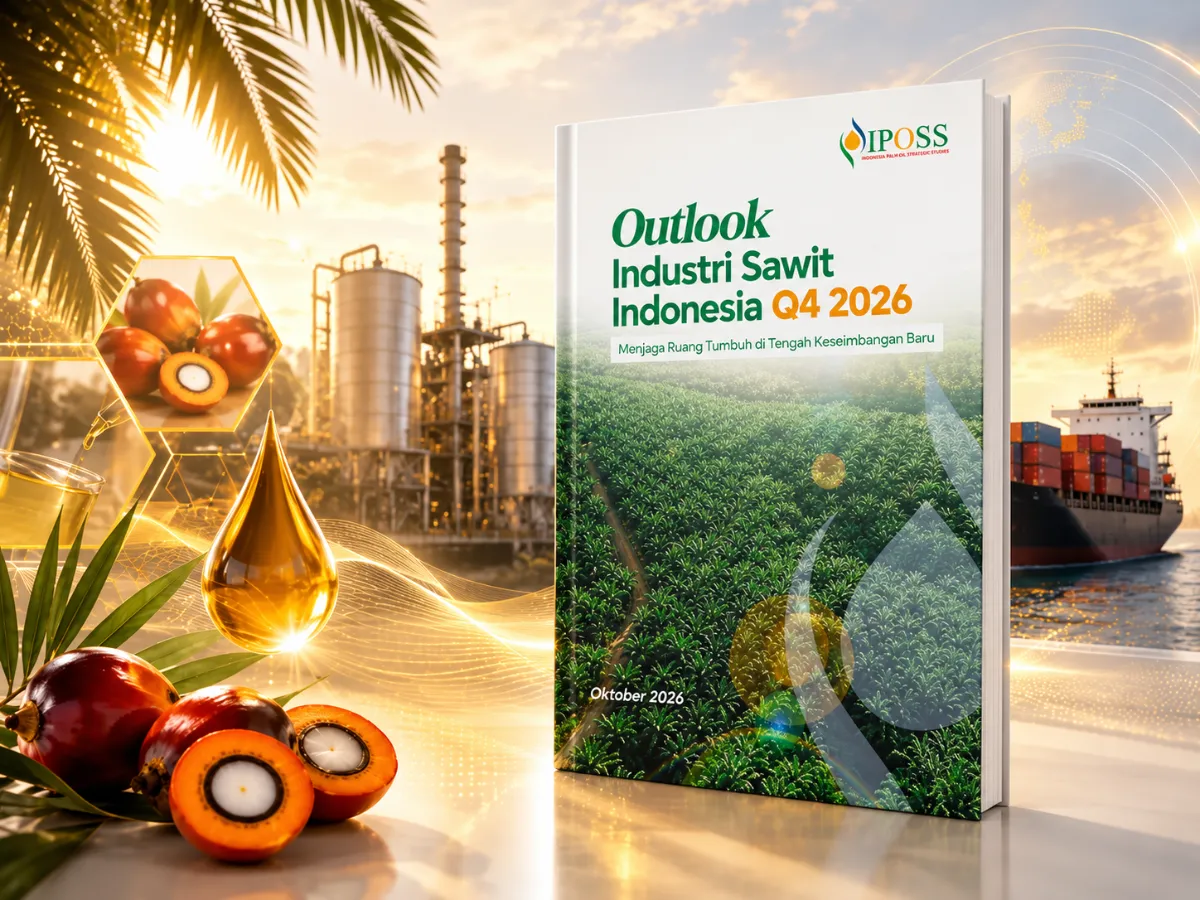
Palm Oil Industry Outlook Q4 2026: Maintaining Growth Space Amid New Equilibrium

Palm Oil Industry Outlook Q2 2026: Geopolitical Disruptions and the Resilience of the Palm Oil Industry Amid the Energy Transition
