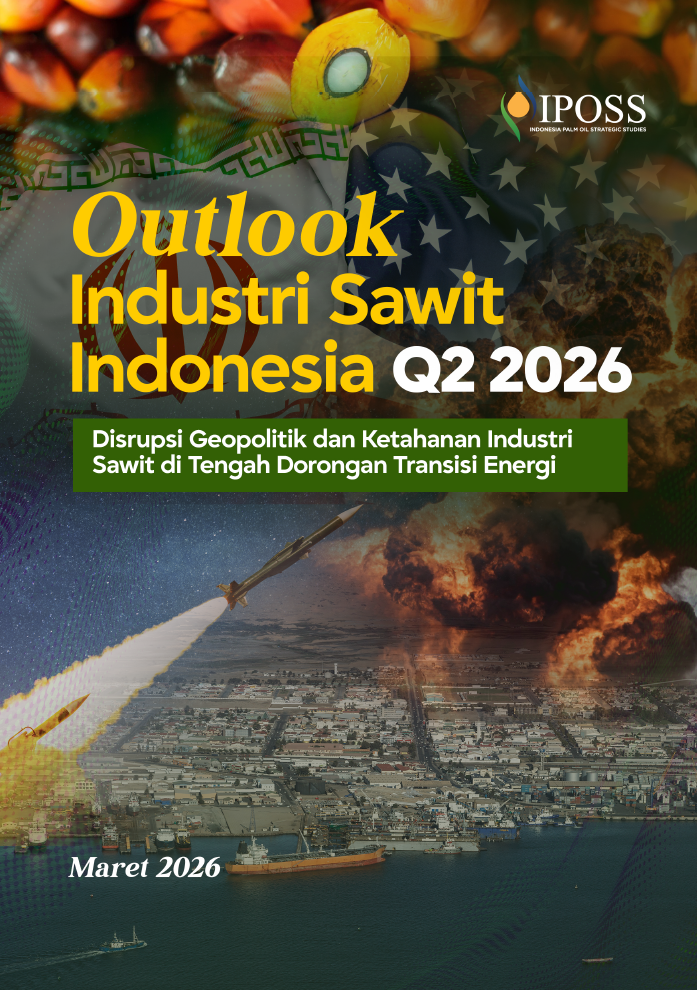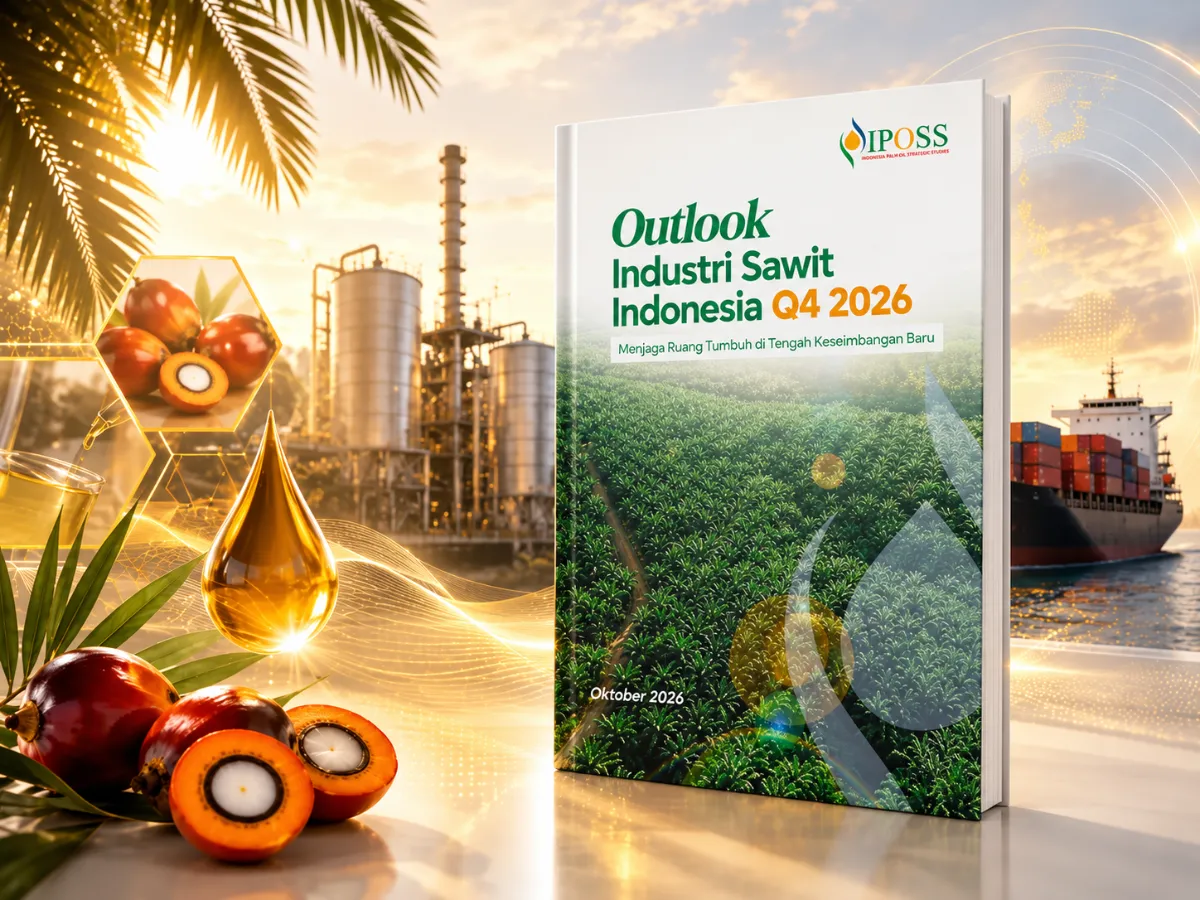
Palm Oil Industry Outlook Q4 2026: Maintaining Growth Space Amid New Equilibrium
Indonesia Palm Oil Strategic Studies (IPOSS) has released the Indonesia Palm Oil Industry Outlook for Q4 2026 with the theme “Maintaining Growth Space Amidst a New Balance.” This theme reflects the changes in the structure of Indonesia's palm oil industry at the end of 2026, when domestic demand takes an increasingly larger share, while production growth is relatively limited and exports maintain a strategic position. In this situation, growth space is no longer solely related to increasing production, but to the industry's ability to enhance productivity, maintain export space, create domestic added value, and ensure market access and business certainty.
Indonesia's palm oil production in 2026 is projected to reach approximately 52.4 million tons. Throughout the year, production distribution shows a fairly dynamic pattern, with high production in Q2, weakening in Q3, then projected to increase from around 11.5 million tons in Q3 to 13.3 million tons in Q4. The increase in Q4 is expected to more reflect changes in inter-quarter production distribution, with larger production volumes concentrated in November and December, and not yet indicating a structural increase in production capacity. This dynamic occurs amidst the influence of agro-climatic conditions, when the beginning of Q4 still carries dry pressure from the previous period, while rainfall is expected to gradually improve towards November and December.
This production dynamic ultimately determines the space for fulfilling domestic needs, exports, and stock formation. In 2026, domestic consumption is projected to reach around 27.1 million tons, while palm oil product exports are about 25.76 million tons. For the first time in the Outlook observation period, domestic usage takes a share of about 51.3%, surpassing exports at 48.7%. This change marks the formation of a new balance, where the domestic market increasingly determines the allocation of national supply and the space between domestic needs, exports, and stock formation becomes tighter.
In Q4, the dynamics become more apparent. With production around 13.3 million tons, domestic consumption around 7.2 million tons, and exports around 4.9 million tons, Q4 is projected to generate a supply flow surplus of about 1.2 million tons. This condition allows stocks, which had dropped to around 0.3 million tons in October, to increase again to about 1.0 million tons in November and 1.7 million tons in December. However, this stock increase does not immediately indicate that supply has become loose again. The rebuilding of stocks occurs alongside a decrease in exports from around 5.9 million tons in Q3 to 4.9 million tons in Q4. Thus, part of the space to rebuild inventory is also formed because the volume going out through exports is reduced.
This supply balance is also reflected in price developments. Based on IPOSS modeling, global CPO prices referencing Bursa Malaysia Derivatives (BMD) are projected to move relatively stable throughout Q4, from around USD1,156 per ton in October, to USD1,144 in November and USD1,147 in December 2026. In the domestic market, CPO prices are estimated to be in the range of IDR 15,666–IDR 15,851 per kilogram. The increase in domestic demand, especially for biodiesel, supports CPO demand. However, stock developments, weakening exports, competition with other vegetable oils, and the influence of the Export Levy and Export Duty on exporters' netback keep the room for price increases limited.
Changes in the balance are also reflected in the structure of Indonesia's palm oil trade. Total palm oil product exports in 2026 are projected to decrease to around 25.8 million tons, or about 48.7% of the total palm oil usage allocation, with the decline occurring not only in crude CPO but also in processed products. The fraction of CPO, which remains the largest component of exports with a share of about 66%, is projected to decrease from around 20.6 million tons in 2025 to 17.1 million tons in 2026. This condition is important because, although export space is narrowing, palm oil still plays a significant role in supporting Indonesia's trade balance. In the first half of 2026, the non-oil and gas trade balance recorded a surplus of about USD19.3 billion. Illustratively, if the value of palm oil and its derivative exports of USD19.4 billion were excluded from the calculation, the surplus would turn into a deficit of about USD110 million. This shows the significant role of palm oil exports in supporting Indonesia's non-oil and gas trade surplus.
Palm oil now performs two increasingly important economic functions: generating foreign exchange through exports, while also creating economic value domestically through CPO processing and energy import substitution. The strengthening of this domestic function becomes more evident after the implementation of the B50 mandate since July 2026. Palm oil consumption for biodiesel is estimated to increase by about 1.7 million tons, from 13.6 million tons in 2025 to 15.3 million tons in 2026, or contributing about 90% of the total additional domestic consumption throughout the year. However, the strengthening role of palm oil in the domestic market occurs when production growth is relatively limited. In this condition, maintaining the balance between domestic needs and exports becomes increasingly important because exports not only generate foreign exchange but also serve as one of the bases for Export Levy revenue that supports various palm oil programs, including biodiesel. Therefore, the narrowing of export space not only impacts trade but also potentially narrows the financing base for palm oil industry development programs.
In this situation, the additional domestic demand cannot continuously be met by reducing export space or relying on stock depletion. As the expansion of the area becomes increasingly limited, increasing productivity and accelerating Smallholder Oil Palm Replanting (PSR) become increasingly important as sources of future production capacity enhancement. The PSR area planted from 2017–2023, which will enter the production phase in 2026, is estimated to reach approximately 251,000 hectares and produce around 943,700 tons of CPO, or roughly equivalent to 2% of national CPO production. This contribution indicates that PSR yields are beginning to enter the national production base, but the scale and acceleration still need to be increased to become one of the sources of future national production growth.
However, the growth space for the palm oil industry is not only determined by the ability to increase production. Growth space also needs to be built through the ability to maintain markets, strengthen trade governance, and ensure business certainty. In the context of market access, readiness to face the EUDR becomes increasingly important as it will determine the ability of Indonesian palm oil products to meet traceability demands while maintaining their position in the European Union market and the increasingly demanding global market for proof of origin and product sustainability.
On the trade side, the development of the Strategic Mineral and Commodity Exchange (BMKS) should not merely be seen as an instrument to increase transaction transparency and price formation credibility. In the future, this trade infrastructure needs to be developed to also strengthen Indonesia's competitiveness and bargaining position in international palm oil trade. Meanwhile, in terms of business certainty, the legality and sustainability of Land Use Rights (HGU) are important parts of maintaining the investment climate and the sustainability of the production base. Thus, maintaining the growth space of the palm oil industry means not only increasing production capacity but also ensuring products have market access, trade can create value credibly, and the production base obtains certainty to remain sustainable.
Through the Indonesian Palm Oil Industry Outlook Q4 2026, IPOSS emphasizes that the challenge entering 2027 is not choosing between domestic needs and exports. Both still have strategic functions and provide value through different channels. The more fundamental challenge is how to create additional capacity so that increasing domestic demand can continue without sacrificing export space, stock adequacy, and industry competitiveness.
In this perspective, a new balance requires new growth space. This space does not merely come from area expansion but from increased productivity, replanting and strengthening of smallholder plantations, efficiency, risk management capability, market access maintenance, credible trade governance, and business certainty. This outlook is expected to serve as a reference for the government, business actors, smallholders, academics, media, and other stakeholders in understanding the development of the palm oil industry at the end of 2026 and preparing steps to enter 2027.
Read the report
More from Palm Oil Outlook
Palm Oil Industry Outlook Q3 2026: Strengthening Domestic as a Global Palm Oil Direction Setter
Palm Oil Industry Outlook Q2 2026: Geopolitical Disruptions and the Resilience of the Palm Oil Industry Amid the Energy Transition