Policy Briefs and Papers
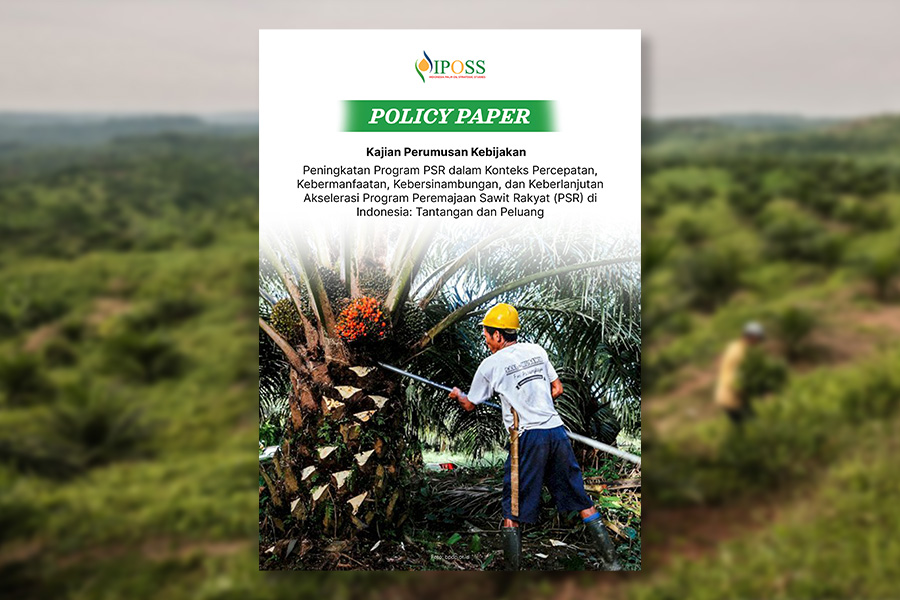
Acceleration of the Smallholder Oil Palm Replanting (PSR) Program in Indonesia: Challenges and Opportunities
Published September 18, 2025
449 views
Download IndonesianEnglish version not available yet
The Smallholder Oil Palm Replanting (PSR) Program is a strategic government policy aimed at enhancing the sustainability of smallholder oil palm plantations. Its primary goal is to improve the welfare of smallholders by increasing harvest yields. The rejuvenation of old plants with new ones using better technical culture, including the use of superior seeds, will positively impact optimal plant growth and higher productivity. The increased production by smallholders as a result of the PSR program is expected to strengthen their position in the palm oil industry supply chain, ultimately supporting national energy and food security programs.
However, the program's realization is far from the target, with an average annual achievement of only 47,000 hectares (calculated from 2020-2024). If the program's achievement does not change, by 2060, only 1.5 million hectares of smallholder oil palm can be rejuvenated. In 2020, there were 2 million hectares of oil palm land that had already reached old age and low productivity. Over time, the area of plants reaching old age will increase each year, automatically reducing productivity.
Therefore, accelerating the PSR program is urgently needed to not only conduct business as usual but also to promote appropriate, effective, and accountable policies. This policy paper is prepared as a study document for proposed changes to the PSR policy.
The study in this policy paper uses a mixed-method approach, combining quantitative and qualitative methods to analyze data from various sources. The data used includes primary data obtained from field data collection through focus group discussions (FGD) and surveys of 303 smallholders in Asahan Regency – North Sumatra, Sekadau Regency – West Kalimantan, and Kampar Regency - Riau.
The survey results found that the realization of the PSR program is significantly hindered by 5 main issues. First, the funding aspect, where although PSR provides financial assistance of IDR 30 million per hectare (increased to IDR 60 million in 2024), this amount does not include the costs of PSR preparation, and in some locations, it is insufficient to cover the actual rejuvenation costs to meet technical culture according to good agricultural practices (GAP) principles. Second, land legality issues, which include the requirement for a Land Ownership Certificate (SHM), which tends not to be owned by all farmers. A more severe issue is the overlap of oil palm land with forest areas or Business Use Rights (HGU), which requires a certificate issued by the relevant ministry. Third, the institutional aspect, where only 34.84% of smallholders are actually part of cooperatives or farmer groups, while the rest are independent smallholders who have not formed groups, making it difficult in the initial PSR preparation stage, namely the formation of farmer groups. Fourth, the lack of proper assistance, where the existing assistance is minimally felt due to the low frequency of assistance provided in a year (an average of only 2 times), even though 77% of smallholders reported having received assistance, only 23.5% felt the benefits of the assistance provided. Lastly, the fifth issue is administrative constraints. Administrative preparation is a particular difficulty for farmers, whether through the PSR application process via the agency or partnership route, which takes a relatively long time to prepare. The agency route can take 6 to 24 months, far exceeding the ideal time expected by smallholders, which is 3 months.
Therefore, policy breakthroughs are needed to overcome these obstacles, including strengthening cross-ministerial and agency coordination, increasing technical and budgetary support for PSR preparation through strengthening program socialization and assistance driven directly by the central government through various schemes and involving competent parties, optimizing the digitalization of PSR progress, and developing a Livelihood Strategy Plan (LSP) scheme to provide a "jadup" or living allowance in the form of a fixed income for smallholders during the non-productive plant period (3 years).
Active participation from all stakeholders is required for the success of this program, from the central government, local governments, cooperatives, assistance personnel, verifiers, to oil palm plantation companies that should be partners, for the future success of PSR. Without the active involvement of all these parties, the government's hope to boost national palm oil production through the PSR program will never be achieved.
Keywords: PSR, Productivity, Smallholder Institutions, Land Legality, Sustainable Energy
Download here
Read the report
More from Policy Briefs and Papers
Policy Briefs and Papers
Contribution of the Palm Oil Industry in Decarbonization Efforts in the Aviation Sector: A Development Update
September 18, 2025
Policy Briefs and Papers
Governance and Trade of Used Cooking Oil (UCO) in Supporting Renewable Energy Program in Indonesia
September 18, 2025
Policy Briefs and Papers
Incentive Strategy to Strengthen the Domestic UCO Market in Efforts to Support the National Sustainable Aviation Fuel (SAF) Industry
September 18, 2025